Start one thing at a time. Many people try to start every change at once because they want to fix the problem fast. If something makes you feel worse, you won’t know which change caused it.
Talk to Your Doctor First
Please have a doctor or pharmacist review any changes you plan to make. These supplements and foods don’t know your medical history, and some can be harmful with certain health conditions or medicines.
Example: Licorice
Conditions most at risk
- High blood pressure. Licorice can raise blood pressure or worsen existing hypertension. One study found that about 100 mg/day of glycyrrhizic acid can raise blood pressure significantly
- Low potassium (hypokalemia). This can be serious and, in extreme cases, fatal.
- Heart disease and arrhythmias. Low potassium can cause irregular heart rhythms, and it can dangerously slow the heart. Heart failure and fluid retention (edema) are also reported.
- Kidney disease. Health Canada, the French food-safety agency ANSES, and WebMD all list kidney problems as a reason for caution.
- Liver disease. ANSES lists liver problems as a sensitivity.
- Muscle disorders. Low potassium can cause hypokalemic myopathy, which can progress to flaccid paralysis or rhabdomyolysis.
- Pregnancy and breastfeeding. ANSES lists both as sensitive situations, and one source links high intake in pregnancy to preterm
- Hormone-sensitive conditions. RxList lists these, with breast cancer as an example
Medication interactions
- Digoxin and diuretics (loop or thiazide) can compound the potassium loss.
- Warfarin may be less effective.
- Fludrocortisone and corticosteroids are also flagged.
Diary
Write things down. Memory often becomes unreliable after a few weeks.
A better approach is to add one new item per week. At the end of the week, decide what to do:
- It clearly helped: Write down the effect in your diary and keep taking it.
- No obvious effect: Usually keep taking it, because some things take several weeks to work.
- It made you feel worse: Stop taking it.
- If the reaction is mild, switch to the next new item.
- If the reaction is severe, take a break until it clears up.
Intervention Pages
The Addition Interventions
The interventions pages lists a Net impact. This is an estimation of the expected impact across all bacteria. This impact is computed from either:
- the odds ratio if available
- the distance outside of the desired range otherwise
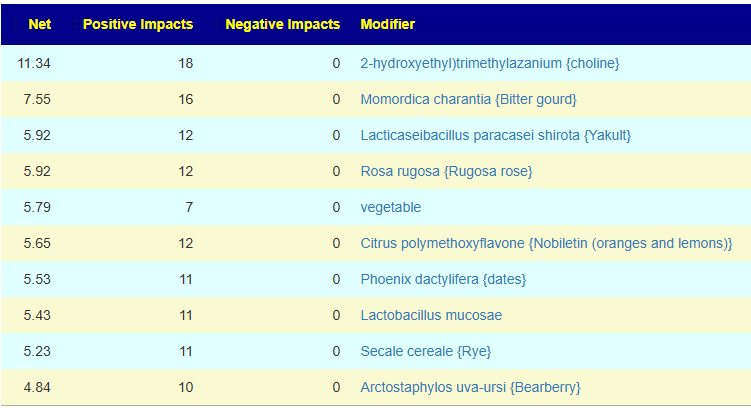
- Positive Impact: this is the number of bacteria that should be improved based on the literature
- Negative Impact: this is the number of bacteria that should be made worse based on the literature
In most cases you want to avoid any negative impact and keep to the highest Net impact with no negative impact.
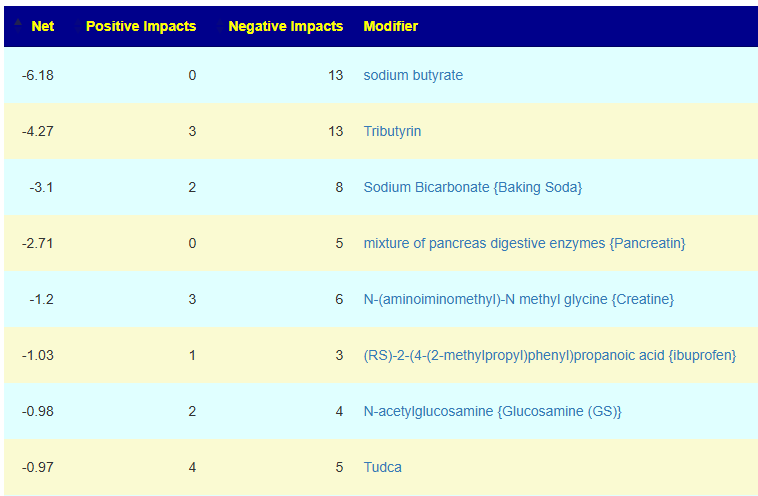
The Removal Interventions
Clicking on Net will show negative substances that may be contributing to your issues. If you are taking these items, you should try to reduce it. Avoid going “cold turkey” and stopping all of them at once.
Slowly reduce or eliminate as time goes on.
Recent Comments