During my Probability and Statistics studies in the early 1970s, I developed a strong interest in Markov chains. The core idea behind a Markov process is straightforward: the next state of a system depends only on its current state and a set of transition probabilities. Given that the microbiome is full of interactions, it seems the ideal model.
In practical terms, this can be represented as a matrix—similar to an Excel spreadsheet—where each column represents an intervention or event, and each row represents a state variable. When a given event occurs, its associated column of values describes how each variable is expected to shift.
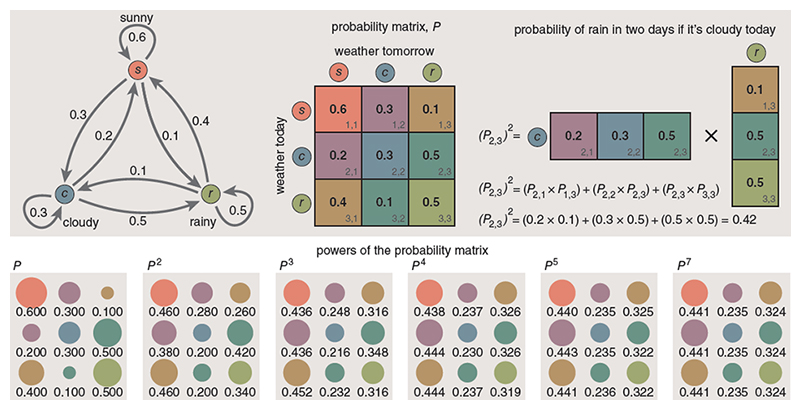
To illustrate this concept in a microbiome context, consider a simplified model using R²-derived relationships between probiotics and bacterial taxa. In this matrix, each value represents the directional influence of a probiotic on a specific bacterium, where zero indicates no measurable effect.
Example interaction matrix:
| Target Bacteria | Pro 1 | Pro 2 | Pro 3 | Pro 4 |
| A | -0.23 | 0.44 | 0.11 | 0.00 |
| B | 0.2 | 0.32 | -0.22 | 0.14 |
| C | 0.18 | -0.11 | 0.11 | 0.12 |
| D | -0.31 | 0.13 | 0.22 | -0.28 |
From this, we can evaluate each probiotic independently by applying its column to the current microbiome state and observing whether each bacterium moves toward or away from its target range.
A simplified qualitative interpretation might look like this:
| Target Bacteria | Pro 1 | Pro 2 | Pro 3 | Pro 4 |
| A | n/a | worse | worse | need improvement |
| B | worse | worse | better | worse |
| C | n/a | worse | better | better |
| D | n/a | worse | worse | better |
In this example, Probiotic 1 appears to be the best initial choice, as it minimizes negative outcomes relative to the others.
Once the first intervention is applied, we update the microbiome to its predicted new state. This updated state becomes the input for the next evaluation cycle. For instance, after adjusting bacterium B, we might find:
| Target Bacteria | Pro 1 | Pro 2 | Pro 3 | Pro 4 |
| B | worse | worse | better | n/a |
This suggests that Probiotic 3 is the most suitable follow-up intervention for B.
In practice, this process must be applied across all bacteria simultaneously—including those currently within the acceptable range—to generate a full predicted microbiome after each intervention. The goal is to evaluate all candidate substances and select the one that produces the greatest overall improvement.
By iterating this process, we can construct a sequence of interventions such as:
- Herb 1
- Probiotic 2
- Diet Change 3
Once a candidate sequence is identified, it is important to test whether the order of interventions materially affects the outcome. This can be done by randomizing the sequence and comparing predicted results. If the sequence proves immaterial, then some interventions may be applied concurrently rather than sequentially.
That is the basic concept, the mathematics are a little more complex. How do you estimate the amount of shift?
A Rule of Thumb
My working assumptions are:
- All bacterial abundances are converted to percentiles, with defined target percentile ranges.
- For probiotics, assume a ±10 percentile shift scaled by the R² relationship for a given bacterium.
- For other substances, estimate impact based on available studies:
- One study: approximately 1 percentile shift.
- Mixed evidence: net effect equals positive studies minus negative studies (e.g., 8 positive and 2 negative yields a 6 percentile shift).
- Cap the maximum effect at 10 percentiles regardless of study volume.
These values are approximations and likely imperfect, but they provide a consistent framework given current data limitations.
Method Summary
- Convert microbiome measurements into percentiles.
- Identify bacteria that fall outside their target ranges.
- Apply each candidate intervention to the current state and compute the predicted microbiome.
- Select the intervention that produces the greatest reduction in out-of-range bacteria (or other chosen objective function).
- Update the microbiome to this predicted state.
- Repeat the process until all bacteria are within range or no further improvement can be achieved.
The result is an ordered sequence of interventions designed to progressively normalize the microbiome. Questions of dosage, duration, and clinical appropriateness are intentionally excluded from this model and should be addressed by qualified professionals.
This is a major transition from “Let us try this and see what happens” to an objective/numeric prioritization based on a reasonable mathematic model. Odds are, that the results will be better for the patient.
Recent Comments