In the decades that I have been working with the microbiome, the scientist in me have become very troubled. Some of the key concerns have been:
- Massive inconsistency between tests results in terms of percentage of different bacteria found [more information]
- Medical practitioner picking certain key bacteria to focus on based on rote or hearsay.
- No studies showing any bacteria are more important than other possible bacteria.
- Suggestions often do not consider counter-indication / adverse effects on other bacteria
- Healthy ranges are determined using normal distributions (Normal Range) which is grossly invalid given the typical bacteria distributions [more information]
Microbiome Prescription current suggestion algorithms appears to have over a 75% chance of improving microbiome tests results (with typical subjective improvement reported) [more information]. For those not responding well to those suggestions, I have been researching an alternative, more rigorous, approach based on computationally intense computation. This method is not practical to run on a website, instead it is computed off-line and then emailed to the person.
The new suggestions are based on the following:
- Using Percentile ranking for better comparison
- Using Odds Ratios (a rigorous statistical process using P < 0.001) to select bacteria
- Every suggestion is checked against every selected bacteria to insure no adverse effect
For more details see “A Proposed Model for Clinical Use of the Human Microbiome“
The new suggestions set consists of three reports:
- Focus on the top 20 bacteria associated with being unhealthy
- Focus on the top 20 bacteria associated with being healthy
- Focus on the top 40 bacteria associated with both unhealthy and healthy
Selection is based on the statistical significance. Why three? As more and more bacteria are added to the target bacteria, the fewer modifiers are left that does not have adverse effect on some of the bacteria.
A knowledgeable reader raised some very valid questions here: Questions about using Odds Ratio
Example Reports:
Unhealthy Bacteria
The goal is to shift the bacteria outside of the unhealthy range. Often it is to eliminate it, but in other cases it may be just to push it up and outside the range.
- Nostocaceae [family] [1162] 47.5 %ile Unhealthy Range [14 – 88], Plan:Decrease
Signif: 36.74, Odds:-4.34
Decreases This Bacteria- No Substances without adverse effect on other bacteria
- Klebsiella [genus] [570] 46.1%ile Healthy Range [1 – 56], Plan:Increase
Signif: 26.39, Odds:-3.40
Increases This Bacteria- 4 :non-starch polysaccharides @Sugar and similar
- 2 :Catechol {Catecholamines} @Flavonoids, Polyphenols etc
- 2 :Escherichia coli:DSM 16441-16448 {symbioflor-2} @Probiotics
- 2 :Ceratonia siliqua {carob} @Food (excluding seasonings)
- 2 :115 different soil based taxa {General Biotics Equilibrium} @Probiotics
- 2 :Laurencia tristicha {Marine red algae} @Food (excluding seasonings)
- 2 :L-3-hydroxytrimethylaminobutanoate {carnitine} @Amino Acid and similar
Healthy Bacteria
The goal is to shift into the optimal range
- Enterococcaceae [family] [81852] 87.2%ile Healthy Range [1 – 66], Plan:Decrease to Healthy Range
Signif: 20.57, Odds:0.97
Decreases This Bacteria- 7 :Shen Ling Bai Zhu San {参苓白术散} @Herb or Spice
- 6 :Sambucus nigra L. ssp. canadensis {Elderberry} @Food (excluding seasonings)
- 5 :Chamaemelum nobile {Camomile} @Herb or Spice
- 5 :Olea europaea {Olive leaf} @Herb or Spice
- 5 :Ocimum tenuiflorum {Tulsi} @Herb or Spice
- 5 :Micromeria fruticosa {White-leaved Savory} @Herb or Spice
- 5 :Eucalyptus {Gum Tree} @Food (excluding seasonings)
- 5 :Arctostaphylos uva-ursi {Bearberry} @Food (excluding seasonings)
- 4 :helichrysum italicum {Immortelle} @Herb or Spice
- 4 :Dysphania ambrosioides {Epazote} @Food (excluding seasonings)
- 4 :Sinapis alba {yellow mustard} @Food (excluding seasonings)
- 4 :Cathelicidin antimicrobial peptide {LL37} @Amino Acid and similar
- 3 :Bixa orellana {annatto } @Herb or Spice
- 3 :Rhus coriaria {Sumac} @Herb or Spice
- 2 :Withania somnifera {Ashwagandha} @Herb or Spice
- Streptococcus alactolyticus [species] [29389] 99.0%ile Healthy Range [1 – 75], Plan:Decrease to Healthy Range
Signif: 17.33, Odds:1.55
Decreases This Bacteria- 5 :Olea europaea {Olive leaf} @Herb or Spice
- 5 :Micromeria fruticosa {White-leaved Savory} @Herb or Spice
- 5 :Eucalyptus {Gum Tree} @Food (excluding seasonings)
- 5 :Sodium Bicarbonate {Baking Soda} @Common and OTC Supplements
- 5 :Prunus mume {Umeboshi} @Food (excluding seasonings)
- 4 :helichrysum italicum {Immortelle} @Herb or Spice
- 4 :chlorhexidine @Common and OTC Supplements
- 3 :Bixa orellana {annatto } @Herb or Spice
- 3 :Rhus coriaria {Sumac} @Herb or Spice
- 2 :Withania somnifera {Ashwagandha} @Herb or Spice
- 2 :Bifidobacterium longum subsp. longum BB536 {BB536} @Probiotics
- 2 :Xylaria hypoxylon {candlesnuff fungus} @Food (excluding seasonings)
Both Healthy and Unhealthy
Because the number of bacteria increases, the number of modifiers decrease,
- Nostocaceae [family] [1162] 47.5 %ile Unhealthy Range [14 – 88], Plan:Decrease
Signif: 36.74, Odds:-4.34
Decreases This Bacteria- No Substances without adverse effect on other bacteria
- Klebsiella [genus] [570] 46.1%ile Healthy Range [1 – 56], Plan:Increase
Signif: 26.39, Odds:-3.40
Increases This Bacteria- 4 :Catechol {Catecholamines} @Flavonoids, Polyphenols etc
- 3 :Escherichia coli:DSM 16441-16448 {symbioflor-2} @Probiotics
- 3 :L-3-hydroxytrimethylaminobutanoate {carnitine} @Amino Acid and similar
- Acidaminococcus [genus] [904] 55.2%ile Healthy Range [21 – 65], Plan:Increase
Signif: 23.71, Odds:-3.42
Increases This Bacteria- No Substances without adverse effect on other bacteria
- Thiotrichaceae [family] [135617] 19.6%ile Unhealthy Range [7 – 100], Plan:Decrease
Signif: 23.27, Odds:-3.42
Decreases This Bacteria- No Substances without adverse effect on other bacteria
- Oscillospira guilliermondii [species] [119853] 67.1%ile Healthy Range [2 – 71], Plan:Increase
Signif: 22.46, Odds:-3.37
Increases This Bacteria- No Substances without adverse effect on other bacteria
- Fusobacterium [genus] [848] 43.3%ile Healthy Range [1 – 70], Plan:Increase
Signif: 20.81, Odds:-1.67
Increases This Bacteria- 6 :Citricidal {Grapefruit seed extract} @Food (excluding seasonings)
- 2 :pediococcus acidilactici {P acidilactici} @Probiotics
The Avoid List
This lists the items with the number of bacteria it may adversely impact.
Counter Indicated Modifiers
- 18 :Slow digestible carbohydrates. {Low Glycemic} @Diet Style
- 16 :Bovine Milk Products {Dairy} @Food (excluding seasonings)
- 15 :bacillus @Probiotics
- 15 :whole-grain diet @Diet Style
- 15 :bacillus,lactobacillus,streptococcus,saccharomyces probiotic @Probiotics
- 14 :Hordeum vulgare {Barley} @Food (excluding seasonings)
- 14 :dietary fiber @Diet Style
- 14 :High-fibre diet {Whole food diet} @Diet Style
- 14 :Lacticaseibacillus paracasei {L.paracasei} @Probiotics
- 14 :Limosilactobacillus reuteri {L. Reuteri} @Probiotics
- 14 :wheat @Food (excluding seasonings)
- 14 :yogurt @Food (excluding seasonings)
- 14 :Fiber, total dietary @Diet Style
- 13 :bacillus subtilis {B.Subtilis } @Probiotics
How do you get these Reports?
When new suitable samples are uploaded, these reports are automatically generated and email within a day.
If you want an older sample processed, just click this link on the site
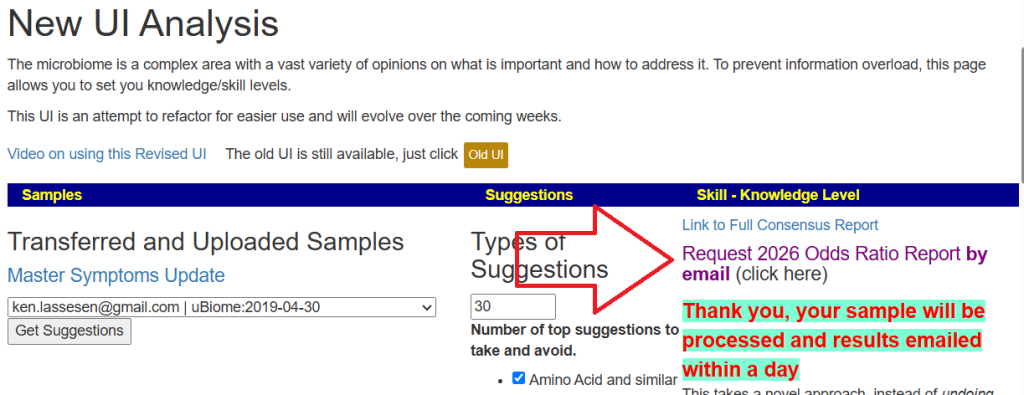
Note: If you do not receive it in 36 hours, check your spam and trash folders.
After some user feedback, a single report is sent. This report looks at bacteria in the unhealthy range and those that are outside of the healthy range. Most bacteria has one OR the other.
Recent Comments