Back in my Uni days, one of my favorite profs taught probability and was a specialist in models of disease spread. A few of her papers below
- Epidemic highs and lows: a stochastic diffusion model for active cases. Journal of Biological Dynamics
- The effect of patterns of infectiousness on epidemic size. Mathematical Biosciences and Engineering 5 (2008), 429-435.
- Bimodal epidemic sizedistributions for near-critical SIR with vaccination. Bulletin of Mathematical Biology 70(2008), 589-602.
- Stochastic epidemic modeling. In: Mathematical and Statistical Estimation Approaches in Epidemiology, Ed. G. Chowell, Springer (2009), 31-52.
Often her work includes the use of Markovian chains. This mathematical framework was a foundation for the work on Microbiome Prescription dealing with bacteria.
Contemporary Pandemics
There are three potential pandemics in scope as summarized in the table below
| Disease | Total Cases | Death Rate | Primary Transmission | Incubation Period | Presymptomatic Transmission |
|---|---|---|---|---|---|
| SARS | 8,422 | 9.6-11% | Respiratory droplets, aerosols, fomites | 2-10 days (median 4-6) | Minimal |
| COVID-19 | 779+ million | Variable (~1-2% overall) | Respiratory droplets, aerosols, surfaces | 4.9-7.5 days | 40-80% of transmission occurs 2-4 days before symptoms |
| Andes Hantavirus | Hundreds (regional) | 36-38% | Rodent excreta inhalation; person-to-person (unique among hantaviruses) | 7-39 days (median 18) | Yes, during early prodromal phase |
SARS (2002-2003)
The SARS outbreak resulted in 8,422 cases worldwide with 916 deaths, yielding a case fatality rate of approximately 9.6-11%. The virus transmits primarily through respiratory droplets, aerosols, and contact with contaminated surfaces (fomites). The incubation period ranges from 2-10 days (median 4-6 days), with most estimates around 5.3 days. SARS transmission occurs primarily after symptom onset, particularly fever, with minimal evidence of presymptomatic transmission.
COVID-19 (2019-Present)
COVID-19 has caused over 779 million confirmed cases and 7.1 million deaths globally as of 2026, with a variable case fatality rate depending on healthcare access and population demographics. The virus spreads through respiratory droplets, aerosols, and surface contact. The mean incubation period is approximately 4.9-7.5 days, depending on the variant and population studied. Critically, 40-80% of COVID-19 transmission occurs 2-4 days before symptom onset, with presymptomatic individuals consistently accounting for over 50-52% of daily new infections.
Andes Hantavirus
Andes virus causes Hantavirus Cardiopulmonary Syndrome (HCPS) with a case fatality rate of 36-38%. While most hantaviruses transmit only through inhalation of aerosolized rodent excreta, Andes virus is unique among hantaviruses in its capacity for person-to-person transmission, which occurs during the early prodromal phase. The incubation period ranges from 7-39 days (median 18 days), with most cases showing symptoms within 14-32 days after brief exposure. A recent cruise ship outbreak in May 2026 reported 8 cases with 3 deaths. Person-to-person transmission has been documented in household clusters and confirmed through genetic sequencing in Argentina and Chile.
Public Health Official Misinformation
Over the last week, I have seen a constant ignorance (failing to read the literature) as well as “calm the masses” speeches. “All Hanta virus are the same”. I did see one news program that did an interview with an informed Harvard professor.
Causes for Anxiety
As you see above, N95 masks are being used for protection for Hanta virus. Properly fitted N95 respirators have a filtration efficiency of 95-99% for viral particles, translating to a failure rate of 1-5% under optimal conditions. To translate it, with 1 person on a flight with 100 souls, up to 5 new infection could be expected. If every one was wearing N-95 properly , then the odds of another new infection become 1 in 400.
Personally, I use P100 masks. The failure rate of P100 respirators is approximately 0.03% for viral particles, compared to N95’s 1-5% failure rate. T
Protection Against Viral Infections
N95 masks reduce the risk of coronavirus infections (SARS-CoV-1 and SARS-CoV-2) by 70% compared to surgical masks (OR 0.30, 95% CI 0.20-0.44). When worn by infected individuals, duckbill N95 masks block 98-99% of COVID-19 viral particles from escaping into the air, reducing transmission risk by up to ninefold when used population-wide and threefold with individual use. [source]
Failure Rates and Limitations
While N95 respirators are highly effective, some penetration occurs at the most challenging particle size (~50 nm). Studies found that penetration rates can slightly exceed 5% at this size, though this may include viral fragments rather than viable infectious particles. The primary failure mode is improper fit rather than filter inadequacy—N95 masks with suboptimal fit still maintain >90% filtration efficiency, but leakage around the edges significantly reduces overall protection. [source]
What will the future reveal?
Detection issue:
For Andes virus specifically, RT-qPCR can detect viral RNA in peripheral blood cells 5-15 days before symptom onset and before antibodies appear. The test demonstrates 94.9% sensitivity and 100% specificity with a very low detection limit of approximately 10 viral copies [source]
So with 42 days before symptoms, a person with Hanta virus will test negative for 27 days (while being contagious), This is very different from the other two virus. The significance of this depends on other factors in the Markov matrix. The prior Chile and Argentina outbreaks was for a localized area (effectively local isolation). The current outbreaks have possible cases flying across the world.
Timeline of the 2026 Andes Hantavirus Cruise Ship Outbreak
Pre-Outbreak Period
November 27, 2025 – April 1, 2026: The index case (Case 1), a Dutch adult male passenger, traveled for four months on a road trip through Chile, Uruguay, and Argentina, where he likely contracted the virus.
April 2026
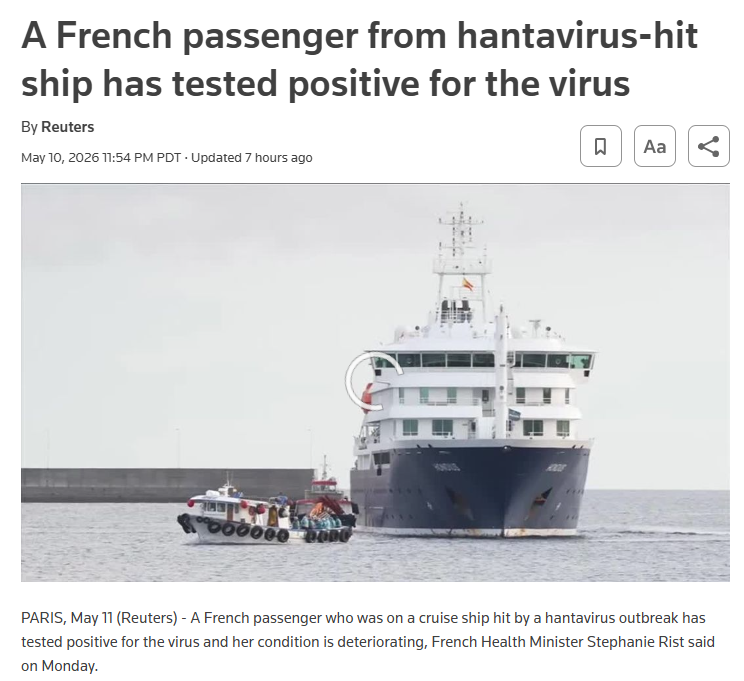
April 1: MV Hondius, a Dutch-flagged cruise ship, departed from Ushuaia, Argentina with 147 passengers and crew from 23 countries.ecdc.europa+1
April 6: Case 1 developed symptoms.who
April 11: Case 1 died onboard the ship; he is considered a probable case (no microbiological tests were performed).
April 24: The ship stopped at Saint Helena, where Case 1’s body was removed and his wife disembarked; 30 passengers total disembarked at this port.wikipedia
April 26: Case 1’s wife died in a Johannesburg, South Africa hospital.wikipedia
May 2026
May 2: The cluster of severe respiratory illness was officially reported to the World Health Organization (WHO) and CDC; at this time, 34 passengers and crew had disembarked from the ship.cdc+2
May 4: WHO confirmed the outbreak publicly and reported seven infections with three fatalities.pbs
May 6: WHO confirmed the specific hantavirus strain as Andes virus (ANDV) through PCR and sequencing; one additional case was identified.cdc+1
May 7: CDC sent a team to meet the cruise ship in the Canary Islands following its travel from Cape Verde; three ill passengers were evacuated.cdc+1
May 8: WHO reported eight total cases (six confirmed, two probable) including three deaths, for a 38% case fatality ratio; all confirmed cases tested positive for Andes virus.
May 9: CDC issued a Level 3 emergency response and classified the situation as a current outbreak; CDC began coordinating repatriation of American passengers to a specialized medical facility in Nebraska.
May 10: MV Hondius arrived at the port of Granadilla, Tenerife, Canary Islands; disembarkation and repatriation flights began.ecdc.europa
May 11 (as of 14:00): European Centre for Disease Prevention and Control (ECDC) reported nine total cases (seven confirmed, two probable).ecdc.europa
- May 15th End of Isolation for persons who meet Patient 1 and did not sail on MV Hondius
- June 25th: End of Isolation for persons who sailed on MV Hondius
- June 25th: End of Isolation for persons who transferred people from MV Hondius (if N95 failure is considered)
Current Status
As of May 11, 2026, passengers are hospitalized across multiple countries including South Africa, the Netherlands, Germany, Saint Helena, Spain, France, and Switzerland. International contact tracing is ongoing through IHR National Focal Points for all passengers and crew who had contact with confirmed cases. The outbreak has drawn global attention as one of the largest and most high-profile hantavirus clusters in recent history, particularly concerning due to confirmed person-to-person transmission of Andes virus.
Worse Case Scenario
An airline staff flying patients home gets infected from N95 mask failure. This person proceed to fly for the next 5 weeks before becoming sick. This is estimated to having 1,680-2,880 unique passenger contacts. This person is likely to also infect all of their fellow workers, yielding over 10,000 exposures.
Fortunately, the airplane’s air filters do better than N95 so the actual numbers would be significantly less,
- Aircraft HEPA / P100 / N100: ~99.97–99.99% removal.
- N95: ≥95% removal (often higher in practice, but certified at 95%).
The Saving Factor
R₀ (basic reproduction number): Average number of people one infected person will infect in a fully susceptible population.
| basic reproduction number | Current Estimates from Literature |
| SARS | 2-4 |
| COVID | 2-3 |
| HANTA | < 1.0 |
If a mutation happens to increase R₀ then we are heading to a new lock down.. We have 8 cases from 1 individual (in a unique environment) which gives a possibility of R₀ being over 1.
Recent Comments