This morning I got this email:
My daughter’s light sensitivity is now so bad, she’s screaming in pain at daylight and won’t let her flatmate put up the blinds! Of course it’s related to her autism. Now we’ve uploaded her new sample, is there anything implicated in her current dysbiosis that might lessen this?
She is tormented by this..
I believe we just have enough data to get some traction. I will first use the new Odds Ratio because it give an objective measurement of the importance of each bacteria. Second, I will use the older methodology to simply get a second opinion of which bacteria (unfortunately, this does not indicate importance of each bacteria).
There are three symptom choices related. The difference in count is a reflection of when the symptom was added (the earliest one had the highest count).
- Neurological-Vision: photophobia (Light Sensitivity) 431 samples
- DePaul University Fatigue Questionnaire : Abnormal sensitivity to light 259 samples
- Other:Light sensitivity (photophobia) 5
The sample above was done using biomesight and we have 148 different bacteria using Odds that are statistically significant for increasing or reducing the odds.
The Odds of her having light sensitivity is quite high: log(Odds)=11.8,
These notes document ongoing work on this issue. The goal is both to address her request and to deepen our understanding of how the MP classic method compares to the newer Odds Ratio approach. The MP classic method has produced good results so far, and Odds Ratios may further improve them. For details on how Odds Ratios are calculated, see this related post: Odds Ratio for the Microbiome 101.
In subsequent posts I will look at two symptoms that are very often seen with light sensisitivy:
- Multiple Chemical Sensitivity
- Mast Cell Activation Syndrome
Comparison of “MP Classic” and Odds Ratio Algorithms
Across all symptoms, using Biomesight data, we see consistent patterns in which bacterial levels are involved. The Odds Ratio analysis focuses on more specific bacterial taxa and is therefore more targeted. For example, instead of simply indicating low Lactobacillus, the Odds Ratio can highlight a particular species such as Lactobacillus reuteri. This higher resolution enables more precise selection of probiotics.
| Taxonomy Rank | MP Classic | Odds Ratio |
| Species | 1727 | 13541 |
| Genus | 5130 | 10040 |
| Family | 8463 | 6158 |
| Order | 5860 | 3269 |
| Class | 3663 | 1437 |
Overview of all Samples
The list of bacteria that DOUBLES or more the odds when present in larger amounts
| Bacteria | Rank | Odds Ratio |
| Salidesulfovibrio | genus | 5.9 |
| Salidesulfovibrio brasiliensis | species | 5.9 |
| Ethanoligenens | genus | 4.9 |
| Peptoniphilus lacrimalis | species | 4.3 |
| Slackia faecicanis | species | 4.2 |
| Collinsella tanakaei | species | 3.8 |
| Finegoldia magna | species | 3.5 |
| Viviparoidea | superfamily | 3.5 |
| Architaenioglossa | order | 3.5 |
| Rivularia | genus | 3.5 |
| Viviparidae | family | 3.5 |
| Rivularia atra | species | 3.5 |
| Rivularia | genus | 3.5 |
| Finegoldia | genus | 3.4 |
| Lysobacter | genus | 3.4 |
| Desulfovibrio fairfieldensis | species | 3.3 |
| Aerococcaceae | family | 3.3 |
| Anaerococcus | genus | 3.2 |
| Streptococcus anginosus | species | 3.1 |
| Luteolibacter | genus | 3 |
| Luteolibacter algae | species | 3 |
| Anaerotruncus colihominis | species | 3 |
| Odoribacter denticanis | species | 3 |
| Filifactor | genus | 2.8 |
| Lactobacillus gallinarum | species | 2.8 |
| Peptoniphilus asaccharolyticus | species | 2.8 |
| Selenomonas infelix | species | 2.7 |
| Corynebacterium striatum | species | 2.7 |
| Adlercreutzia equolifaciens | species | 2.6 |
| Streptococcus anginosus group | species group | 2.6 |
| Glutamicibacter soli | species | 2.6 |
| Anaerotruncus | genus | 2.5 |
| Rubritaleaceae | family | 2.5 |
| Rubritalea | genus | 2.5 |
| Gardnerella | genus | 2.4 |
| Oscillatoriales | order | 2.3 |
| Amedibacillus dolichus | species | 2.3 |
| Amedibacillus | genus | 2.3 |
| Glutamicibacter | genus | 2.2 |
| Anaerococcus prevotii | species | 2.2 |
| Azospirillum palatum | species | 2.2 |
| Eggerthella sinensis | species | 2.2 |
| Sphingomonas abaci | species | 2.2 |
| Alcanivorax | genus | 2.1 |
| Alcanivoracaceae | family | 2.1 |
| Haploplasma | genus | 2.1 |
| Haploplasma cavigenitalium | species | 2.1 |
| Isoalcanivorax | genus | 2.1 |
| Isoalcanivorax indicus | species | 2.1 |
| Oscillatoriaceae | family | 2.1 |
| Selenomonadales | order | 2.1 |
| Nisaea nitritireducens | species | 2.1 |
| Anaerococcus tetradius | species | 2.1 |
| Selenomonadaceae | family | 2.1 |
| Lactobacillus acidophilus | species | 2.1 |
| Anaerococcus lactolyticus | species | 2.1 |
On the other end, the bacteria that reduces the odds when present in higher amounts are:
| Propionibacteriales | order | 0.1 |
| Dyadobacter | genus | 0.3 |
| Herbaspirillum magnetovibrio | species | 0.3 |
| Calditrichia | class | 0.4 |
| Calditrichales | order | 0.4 |
| Calditrichaceae | family | 0.4 |
| Caldithrix | genus | 0.4 |
| Calditrichota | phylum | 0.4 |
| Desulfitobacteriaceae | family | 0.4 |
| Bifidobacterium adolescentis | species | 0.4 |
| Bifidobacterium longum | species | 0.4 |
In terms of probiotics, we see some quick observations: good and bad.
- Two Lactobacillus probiotics significantly increases the odds — i.e. AVOID, especially yogurts!
- Two Bifidobacterium species (and the genus as a whole) significantly decreases the odds — TAKE A LARGER DOSAGE.
Looking at this specific sample
We found no lactobacillus at all, and Bifidobacterium adolescentis is too low. Bifidobacterium longum was found but the amount was significant for reducing the risk.
Getting best probiotics via modelling
This is done using the Correlation Coefficient between bacteria from the R2 site (using the lab specific numbers). We focused solely on the bacteria that increased the odds significantly, and then compute the probiotics (based on only the species what Biomesight reports) that will shift them in the right direction.
| Tax_name | Impact |
| Pediococcus acidilactici | 4.28 |
| Bacillus amyloliquefaciens group | 3.89 |
| Limosilactobacillus vaginalis | 2.95 |
| Bifidobacterium | 2.5 |
| Enterococcus faecalis | 1.73 |
| Bifidobacterium pseudocatenulatum | 1.6 |
| Leuconostoc mesenteroides | 1.6 |
| Heyndrickxia coagulans (bacillus coagulans) | 1.53 |
| Bifidobacterium longum | 1.49 |
| Clostridium butyricum | 1.46 |
| Lacticaseibacillus paracasei | 1.35 |
| Lactococcus lactis | 1.33 |
| Bifidobacterium breve | 1.28 |
| Lactobacillus helveticus | 1.27 |
| Enterococcus faecium | 1.24 |
| Bacillus subtilis group | 1.16 |
| Lactiplantibacillus plantarum | 1.08 |
| Bifidobacterium bifidum | 0.96 |
| Bifidobacterium adolescentis | 0.84 |
Taking these same bacteria using the odds ratios and our usual suggestions engine, we get the following as the top suggestions.
| Modifier | Net | Take | Avoid |
| Slow digestible carbohydrates. {Low Glycemic} | 37 | 52 | 16 |
| dietary fiber | 29 | 45 | 16 |
| Fiber, total dietary | 24 | 38 | 14 |
| fruit | 22 | 34 | 12 |
| fruit/legume fibre | 20 | 32 | 12 |
| (2->1)-beta-D-fructofuranan {Inulin} | 20 | 23 | 3 |
| High-fibre diet {Whole food diet} | 19 | 32 | 13 |
| oligosaccharides {oligosaccharides} | 19 | 26 | 6 |
| whole-grain diet | 18 | 25 | 7 |
| Lactobacillus plantarum {L. plantarum} | 17 | 29 | 12 |
| bifidobacterium | 15 | 16 | 1 |
| wheat | 12 | 14 | 2 |
The Avoids. I noticed that Bofutsushosan is an avoid. This is a promoter of Akkermansia — which was on our avoid probiotics list. There appears to be reasonable consistency although we are using two different sources and mechanism to get these suggestions.
| Modifier | Net | Take | Avoid |
| high-fat diets | -8 | 3 | 11 |
| Ganoderma sichuanense {Reishi Mushroom} | -5 | 1 | 6 |
| Pulvis ledebouriellae compositae {Bofutsushosan} | -4 | 0 | 5 |
| 2-aminoacetic acid {glycine} | -4 | 0 | 4 |
| Bacteriophages LH01,T4D,LL12,LL5 {PreforPro} | -4 | 0 | 4 |
| laminaria hyperborea {Cuvie} | -4 | 0 | 4 |
| low protein diet | -4 | 1 | 6 |
| D-glucose {Glucose} | -4 | 1 | 6 |
| Ferrum {Iron Supplements} | -4 | 1 | 5 |
| Ulmus rubra {slippery elm} | -4 | 2 | 6 |
| Honey {Honey } | -4 | 2 | 6 |
Going Old School Suggestions
This is done the usual way but we temporarily clear all of the symptoms and then just marked this single symptom. We are wanting to focus solely on this one horrible symptom.
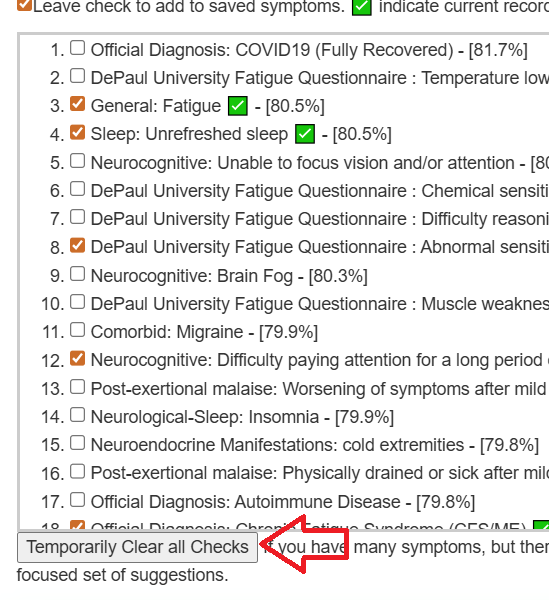
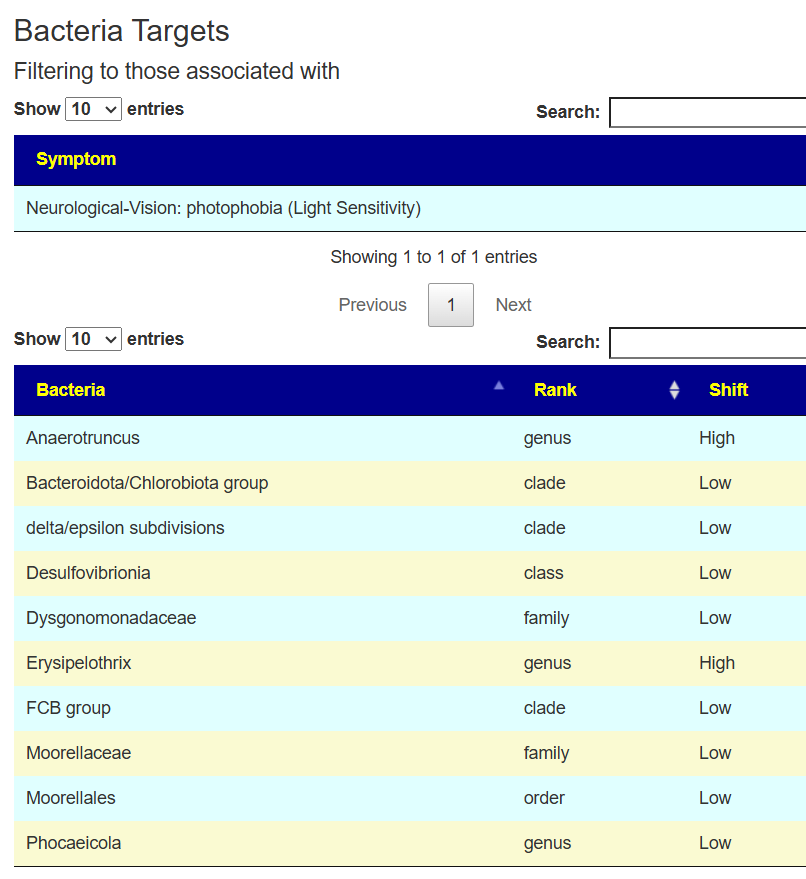
Clicking on this one symptom, we then get 10 bacteria associated
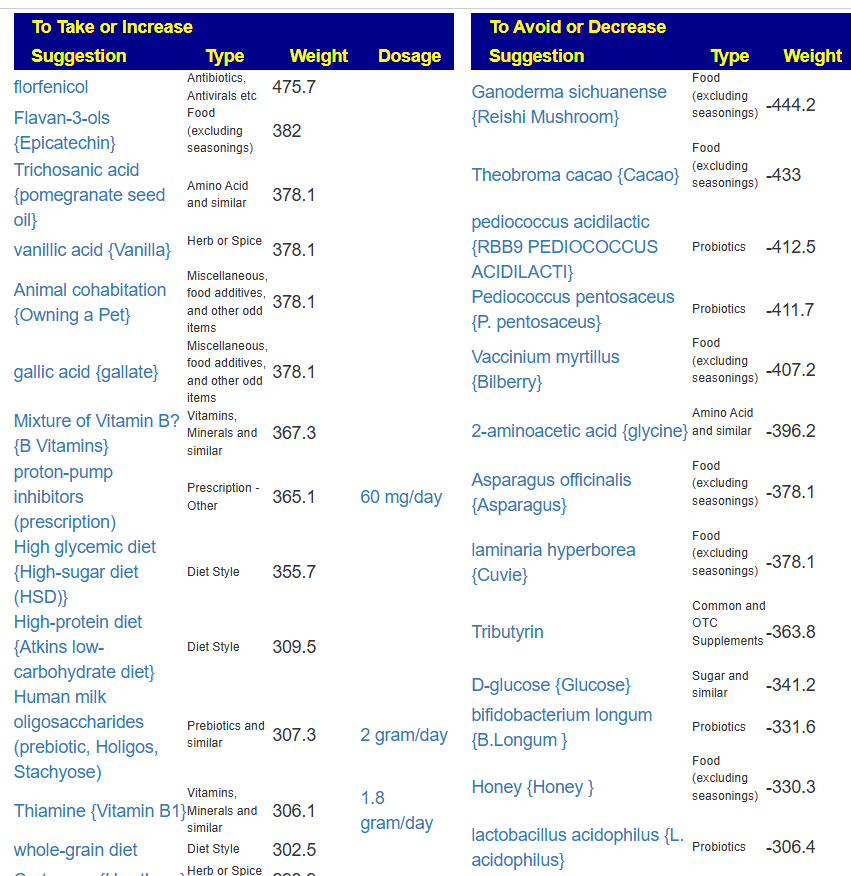
And also suggestions. I note some agreements between the methods:
- Avoids: Honey, Ganoderma sichuanense {Reishi Mushroom},laminaria hyperborea {Cuvie}, etc
- Takes: whole-grain diet, oligosaccharides
- Disagreement: Bifidobacterium Longum – this gets interesting because the Odds Ratio indicate that the amount of Bifidobacterium Longum present was sufficient to reduce the odds to below 1.0
Summary
I generally favor a consensus of recommendations as the safest course. In this case, my impression is that using Odds Ratios leads to better identification of the bacteria involved (10 versus 24 for this sample), with the added benefit of indicating the relative importance of each bacterium. With Odds Ratios, the thresholds for being too high or too low are symptom-specific, rather than some magical universal cutoff that applies to all conditions.
Believing that there is one magic reference range for any bacteria is simply naive and ignoring the data.
I need to do some more refining of the code as well as enhancement to handle multiple symptoms concurrently; in time, this will be added to the sight.
Using Odds Ratio is now available on the site. The video below shows how to access it.
Technical Notes
Doing a low level comparison between the “classic forecast method” and the “Odds Ratio method I generated the table below. The Odds Ratio identified bacteria at a much more at a finer level (species) and most people would interpret that as being more targeted and likely better outcomes.
| Measure | Classic | Odds Ratio |
| Bacteria Considered | 115 | 148 |
| Bacteria in common | 20 | 20 |
| Species | 8 | 57 |
| Genus | 22 | 51 |
| Family | 33 | 21 |
| Order | 23 | 10 |
| Class | 14 | 3 |
This also implies that only Genus and Species should be considered with Odds Ratio. Statistically this is preferred to reduce the amount of double counting.
Revisiting Suggestions using only Genus and Species with Odds Ratio
The R2 Probiotics are similar. Most probiotics are more challenging to obtain — see this page for known sources. The avoids are:
- Lactobacillus johnsonii
- Akkermansia muciniphila
- Bacillus subtilis
Note: Pediococcus acidilactici and L.Plantarum (positive) mixtures is likely the easiest to obtain.
| Tax_name | Impact | Possible Source |
| Pediococcus acidilactici | 4.28 | Imagilin / NutriLots |
| Bacillus amyloliquefaciens group | 3.1 | only in big mixtures 🙁 |
| Limosilactobacillus vaginalis | 1.79 | n/a |
| Bifidobacterium pseudocatenulatum | 1.6 | only in big mixtures 🙁 |
| Leuconostoc mesenteroides | 1.6 | Bulk Probiotics / Leuconostoc Mesenteroides Probiotic Powder |
| Clostridium butyricum | 1.46 | Many sources |
| Lacticaseibacillus paracasei | 1.35 | danactive drink and many others |
| Lactococcus lactis | 1.33 | Bulk Probiotics / Lactococcus Lactis Probiotic Powder |
| Bifidobacterium | 1.04 |
The To Take List
| Modifier | Net | Take | Avoid |
| Slow digestible carbohydrates. {Low Glycemic} | 34 | 47 | 12 |
| dietary fiber | 29 | 40 | 11 |
| Fiber, total dietary | 23 | 35 | 11 |
| fruit | 20 | 30 | 10 |
| oligosaccharides {oligosaccharides} | 20 | 24 | 4 |
| High-fibre diet {Whole food diet} | 19 | 29 | 10 |
| fruit/legume fibre | 19 | 28 | 9 |
| whole-grain diet | 18 | 24 | 5 |
| (2->1)-beta-D-fructofuranan {Inulin} | 17 | 18 | 1 |
| bifidobacterium | 12 | 12 | 0 |
| Lactobacillus plantarum {L. plantarum} | 11 | 22 | 11 |
| wheat | 11 | 12 | 1 |
| 3,3′,4′,5,7-pentahydroxyflavone {Quercetin} | 10 | 11 | 1 |
| Bovine Milk Products {Dairy} | 9 | 13 | 4 |
| Human milk oligosaccharides (prebiotic, Holigos, Stachyose) | 9 | 10 | 1 |
| polyphenols | 8 | 12 | 4 |
The To Avoid List
| high-fat diets | -6 | 1 | 7 |
| Honey {Honey } | -5 | 1 | 6 |
| Pulvis ledebouriellae compositae {Bofutsushosan} | -4 | 0 | 5 |
| 2-aminoacetic acid {glycine} | -4 | 0 | 4 |
| laminaria hyperborea {Cuvie} | -4 | 0 | 4 |
| Vaccinium myrtillus {Bilberry} | -4 | 0 | 4 |
| D-glucose {Glucose} | -4 | 1 | 6 |
| Sodium Chloride {Salt} | -4 | 1 | 5 |
| Ferrum {Iron Supplements} | -4 | 1 | 5 |
| Ulmus rubra {slippery elm} | -4 | 2 | 6 |
| 2-Amino-5-(carbamoylamino)pentanoic acid {Citrulline} | -3 | 0 | 3 |
| Lactotransferrin {Lactoferrin} | -3 | 0 | 3 |
| Sus domesticus {Pork} | -3 | 0 | 3 |
| Ganoderma sichuanense {Reishi Mushroom} | -3 | 1 | 4 |
| low protein diet | -3 | 1 | 3 |
| Theobroma cacao {Cacao} | -3 | 2 | 5 |
Recent Comments