Multiple Chemistry Sensitivity Exploration

A reader with Multiple Chemistry Sensitivity(MCS) read my Light Sensitivity Exploration post and asked me to look at her sample because her MCS has been getting worse and she is hoping to slow and ideally reverse it. She does not want to become an anchorite with complete isolation from people. On her symptom list it is:

  • Comorbid: Multiple Chemical Sensitivity
  • Mast Cell Activation Syndrome (Next Post)

Looking at Comorbidity from our contributed data

  • 14% of people with Photo Sensitivity have MCS, but 89% have MCAS/Histamine issues
  • 17% of people with MCAS/Histamine issues have MCS, but 51% have Photo Sensitivity
Photo SensitivityMCSMCAS
Photo Sensitivity42760383
MCS238135
MCAS753

I am going to skip the explorations that I did in the earlier post. As with prior post, Odds Ratio has better fine level identification.

ClassicOdds Ratio
Bacteria Considered85103
Bacteria In Common1715
Species637
Genus1635
Family2413
Order1710
Class104

Since Light Sensitivity and MCS tends to go hand in hand, I did a comparison of the net Log(odd ratio) between people. A person without these issues is expected to have a Log(Odds Ratio) < 0. This Post’s anchorite has moderate light sensitivity in reality.

PersonLight SensitivityMCS
Last Post Person11.817.3
Anchorite5.716.4

This feature is now available on the web site for samples from Biomesight, Ombre, Thorne and uBiome. How to get to it and use it is shown below.

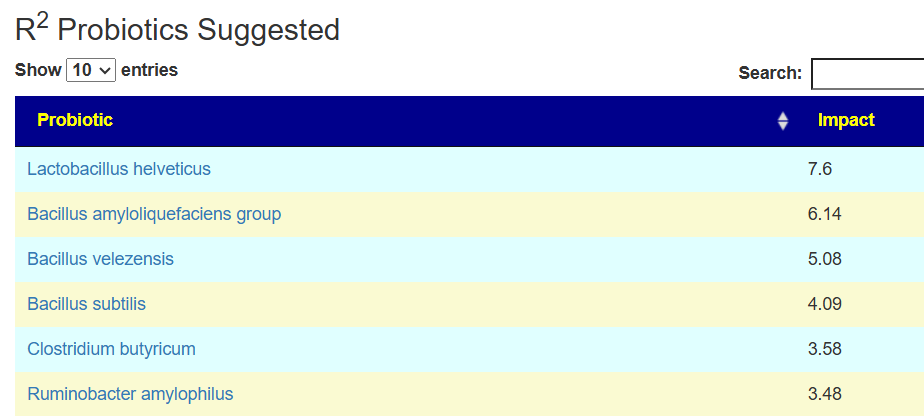
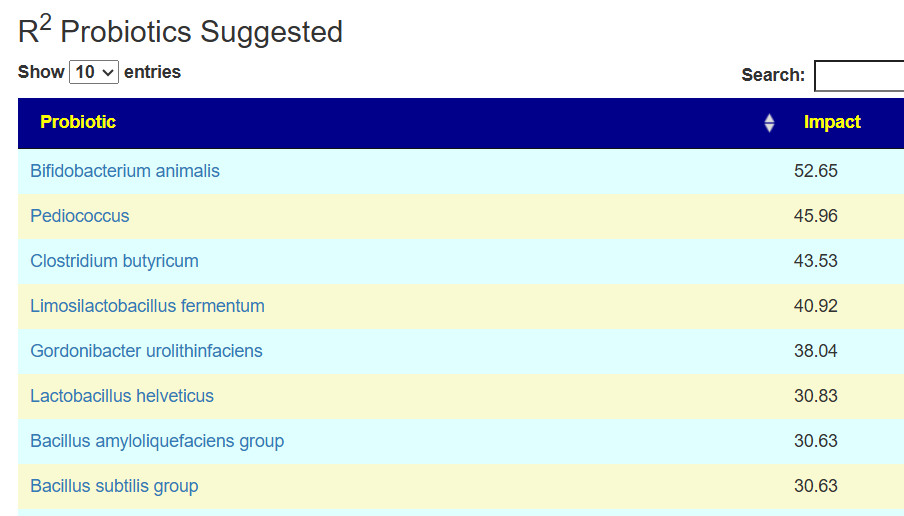
Probiotics Suggestions for MCS

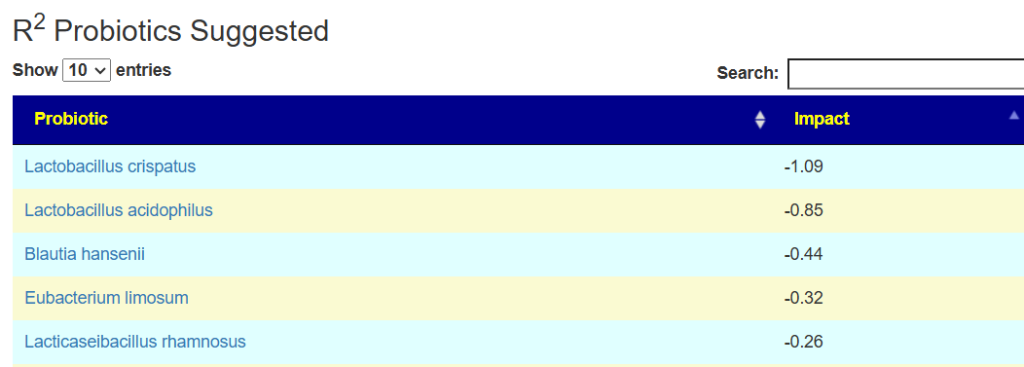
The full list is below (remember only probiotic bacteria reported by Biomesight are included). The list for the Last Post person for MCS was very similar.

Tax_nameImpact
Bifidobacterium longum2.22
Bifidobacterium adolescentis1.92
Enterococcus faecalis1.89
Bifidobacterium breve1.83
Clostridium butyricum1.78
Faecalibacterium prausnitzii1.73
Streptococcus thermophilus1.54
Bifidobacterium bifidum0.89
Bifidobacterium catenulatum0.8
Ruminobacter amylophilus0.55
Bifidobacterium animalis0.51
Bifidobacterium pseudocatenulatum0.51
Enterococcus durans0.47
Lactobacillus johnsonii0.4
Leuconostoc mesenteroides0.33
Roseburia faecis0.32
Veillonella atypica0.23
Lacticaseibacillus paracasei0.2
Phocaeicola coprophilus0.18
Bacillus velezensis0.08
Lactobacillus acidophilus-0.05
Bacteroides thetaiotaomicron-0.23
Bacteroides uniformis-0.3
Limosilactobacillus reuteri-0.3
Bacillus amyloliquefaciens group-0.3
Lentilactobacillus parakefiri-0.31
Phocaeicola dorei-0.32
Bacillus subtilis group-0.32
Limosilactobacillus vaginalis-0.32
Enterococcus faecium-0.33
Bacillus subtilis-0.7
Lactobacillus helveticus-0.85
Lactobacillus jensenii-0.85
Pediococcus acidilactici-1.05

I should note that Pediococcus acidilactici is a high take for Light Sensitivity and a take for MCS for the light sensitive person. It is a to be avoided for the Anchorite in both cases. This goes back to the old saying “No probiotics can serve two people with the same symptoms” (Matt 6:24, Microbiome Translation).

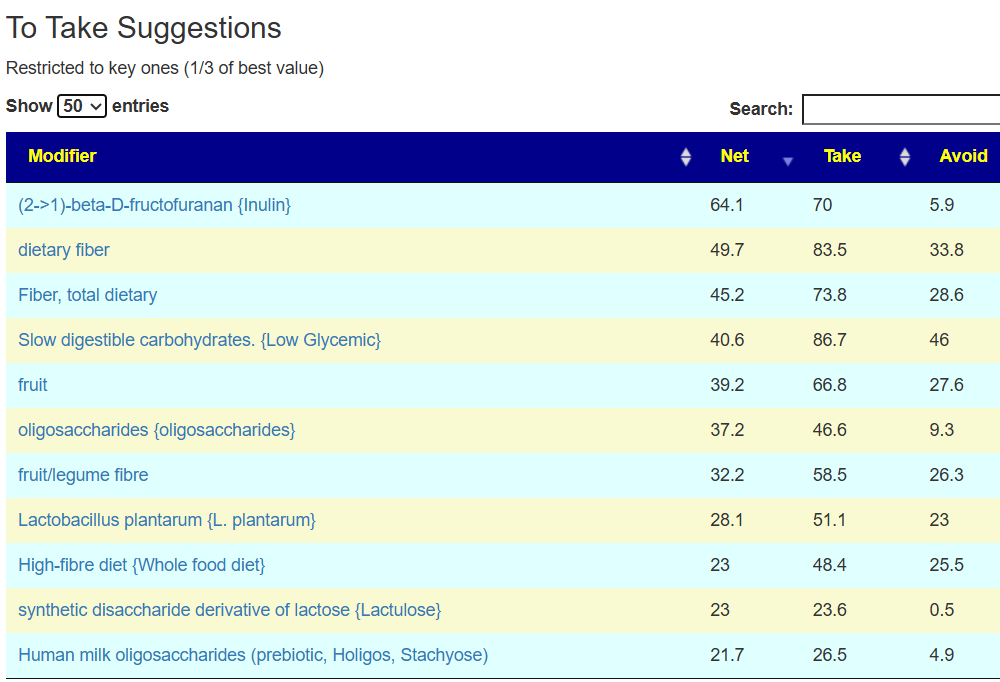
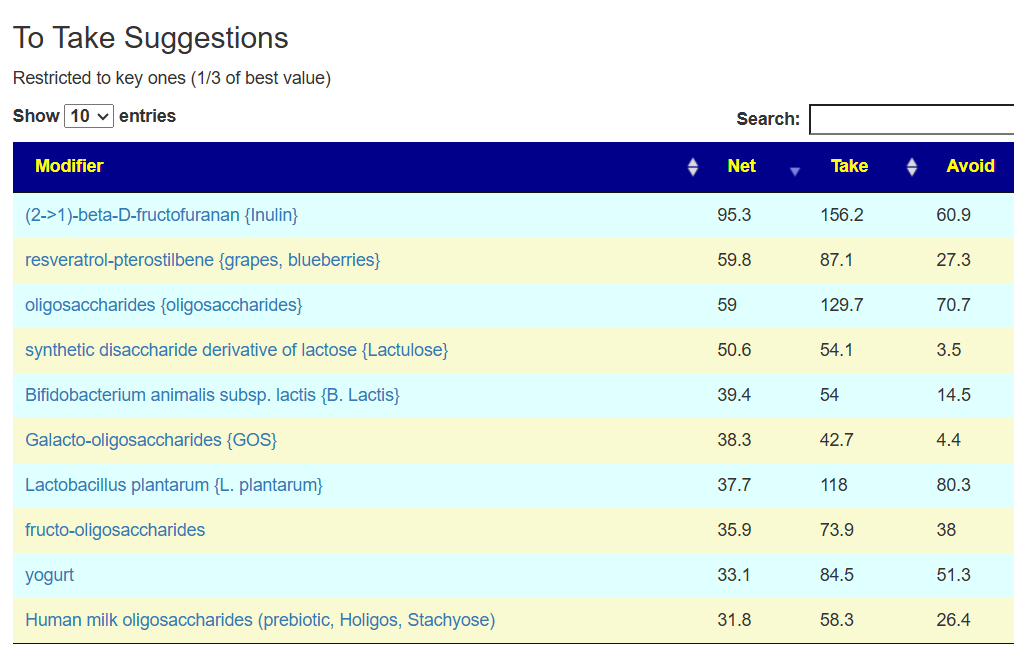
Take Suggestions

These match the general pattern seen for Long COVID and ME/CFS

ModifierNetTakeAvoid
(2->1)-beta-D-fructofuranan {Inulin}1331374
dietary fiber8210625
oligosaccharides {oligosaccharides}789012
Slow digestible carbohydrates. {Low Glycemic}7710629
Fiber, total dietary699121
fruit608021
Lactobacillus plantarum {L. plantarum}506718
fruit/legume fibre486719
fructo-oligosaccharides48513
synthetic disaccharide derivative of lactose {Lactulose}46482
Human milk oligosaccharides (prebiotic, Holigos, Stachyose)38468
Cichorium intybus {Chicory}36393
wheat35406
Hordeum vulgare {Barley}344411
whole-grain diet334613
ß-glucan {Beta-Glucan}33385
High-fibre diet {Whole food diet}324816
Bovine Milk Products {Dairy}324613
resistant starch32408

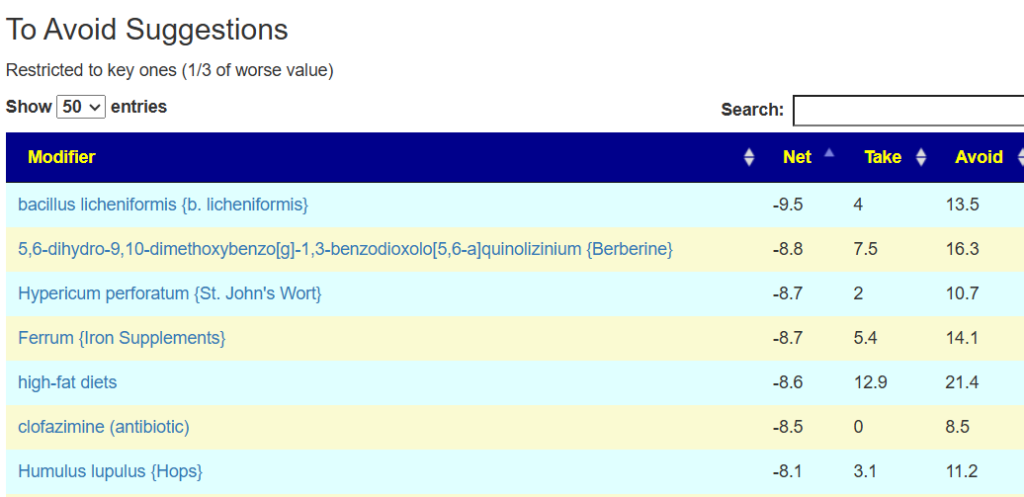
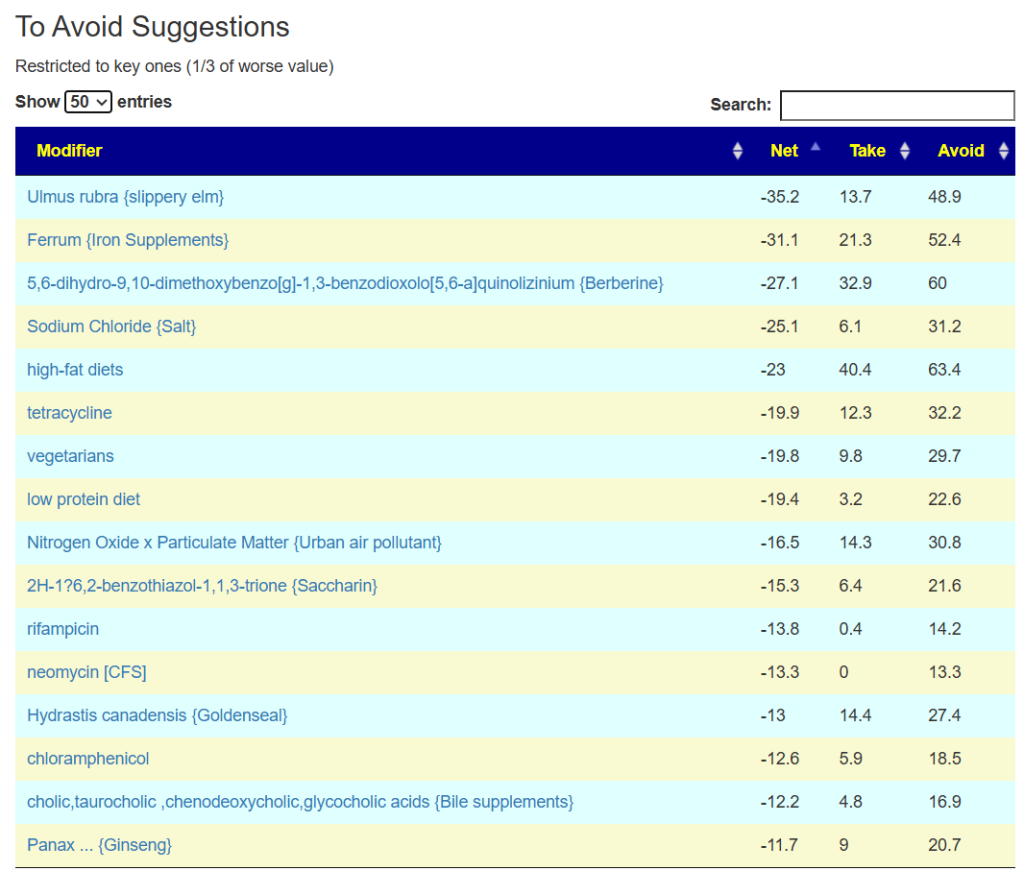
Avoid Suggestions

We have a few herbs or spices showing up as an avoid. When we look at MCAS, we see a very atypical avoid list.

ModifierNetTakeAvoid
Ferrum {Iron Supplements}-26430
high-fat diets-15924
Ethyl alcohol {Grain alcohol}-8310
high red meat-708
 5,6-dihydro-9,10-dimethoxybenzo[g]-1,3-benzodioxolo[5,6-a]quinolizinium {Berberine}-71118
Nitrogen Oxide x Particulate Matter {Urban air pollutant}-628
High-protein diet {Atkins low-carbohydrate diet}-6410
vegetarians-6410
low fodmap diet-6815
Azadirachta indica {Neem}-404
Silver nanoparticles {Colloidal silver}-404

Summary

The new offering is easy to use, just follow the video above. Remember, most symptoms are caused by combinations of bacteria that alters the metabolites (chemicals) that the body gets. There are many distinct combinations that can produce a symptom. Above is NOT a general guidance, it shows the results for a specific person using their microbiome. The suggestions for your microbiome may be different. Testing is not optional if you want to make progress.

Light Sensitivity Exploration

This morning I got this email:

My daughter’s light sensitivity is now so bad, she’s screaming in pain at daylight  and won’t let her flatmate put up the blinds! Of course it’s related to her autism. Now we’ve uploaded her new sample, is there anything implicated in her current dysbiosis that might lessen this?
She is tormented by this..

I believe we just have enough data to get some traction. I will first use the new Odds Ratio because it give an objective measurement of the importance of each bacteria. Second, I will use the older methodology to simply get a second opinion of which bacteria (unfortunately, this does not indicate importance of each bacteria).

There are three symptom choices related. The difference in count is a reflection of when the symptom was added (the earliest one had the highest count).

  • Neurological-Vision: photophobia (Light Sensitivity) 431 samples
  • DePaul University Fatigue Questionnaire : Abnormal sensitivity to light 259 samples
  • Other:Light sensitivity (photophobia) 5

The sample above was done using biomesight and we have 148 different bacteria using Odds that are statistically significant for increasing or reducing the odds.

The Odds of her having light sensitivity is quite high: log(Odds)=11.8,

These notes document ongoing work on this issue. The goal is both to address her request and to deepen our understanding of how the MP classic method compares to the newer Odds Ratio approach. The MP classic method has produced good results so far, and Odds Ratios may further improve them. For details on how Odds Ratios are calculated, see this related post: Odds Ratio for the Microbiome 101.

In subsequent posts I will look at two symptoms that are very often seen with light sensisitivy:

  • Multiple Chemical Sensitivity
  • Mast Cell Activation Syndrome

Comparison of “MP Classic” and Odds Ratio Algorithms

Across all symptoms, using Biomesight data, we see consistent patterns in which bacterial levels are involved. The Odds Ratio analysis focuses on more specific bacterial taxa and is therefore more targeted. For example, instead of simply indicating low Lactobacillus, the Odds Ratio can highlight a particular species such as Lactobacillus reuteri. This higher resolution enables more precise selection of probiotics.

Taxonomy RankMP ClassicOdds Ratio
Species172713541
Genus513010040
Family84636158
Order58603269
Class36631437

Overview of all Samples

The list of bacteria that DOUBLES or more the odds when present in larger amounts

BacteriaRankOdds Ratio
Salidesulfovibriogenus5.9
Salidesulfovibrio brasiliensisspecies5.9
Ethanoligenensgenus4.9
Peptoniphilus lacrimalisspecies4.3
Slackia faecicanisspecies4.2
Collinsella tanakaeispecies3.8
Finegoldia magnaspecies3.5
Viviparoideasuperfamily3.5
Architaenioglossaorder3.5
Rivulariagenus3.5
Viviparidaefamily3.5
Rivularia atraspecies3.5
Rivulariagenus3.5
Finegoldiagenus3.4
Lysobactergenus3.4
Desulfovibrio fairfieldensisspecies3.3
Aerococcaceaefamily3.3
Anaerococcusgenus3.2
Streptococcus anginosusspecies3.1
Luteolibactergenus3
Luteolibacter algaespecies3
Anaerotruncus colihominisspecies3
Odoribacter denticanisspecies3
Filifactorgenus2.8
Lactobacillus gallinarumspecies2.8
Peptoniphilus asaccharolyticusspecies2.8
Selenomonas infelixspecies2.7
Corynebacterium striatumspecies2.7
Adlercreutzia equolifaciensspecies2.6
Streptococcus anginosus groupspecies group2.6
Glutamicibacter solispecies2.6
Anaerotruncusgenus2.5
Rubritaleaceaefamily2.5
Rubritaleagenus2.5
Gardnerellagenus2.4
Oscillatorialesorder2.3
Amedibacillus dolichusspecies2.3
Amedibacillusgenus2.3
Glutamicibactergenus2.2
Anaerococcus prevotiispecies2.2
Azospirillum palatumspecies2.2
Eggerthella sinensisspecies2.2
Sphingomonas abacispecies2.2
Alcanivoraxgenus2.1
Alcanivoracaceaefamily2.1
Haploplasmagenus2.1
Haploplasma cavigenitaliumspecies2.1
Isoalcanivoraxgenus2.1
Isoalcanivorax indicusspecies2.1
Oscillatoriaceaefamily2.1
Selenomonadalesorder2.1
Nisaea nitritireducensspecies2.1
Anaerococcus tetradiusspecies2.1
Selenomonadaceaefamily2.1
Lactobacillus acidophilusspecies2.1
Anaerococcus lactolyticusspecies2.1

On the other end, the bacteria that reduces the odds when present in higher amounts are:

Propionibacterialesorder0.1
Dyadobactergenus0.3
Herbaspirillum magnetovibriospecies0.3
Calditrichiaclass0.4
Calditrichalesorder0.4
Calditrichaceaefamily0.4
Caldithrixgenus0.4
Calditrichotaphylum0.4
Desulfitobacteriaceaefamily0.4
Bifidobacterium adolescentisspecies0.4
Bifidobacterium longumspecies0.4

In terms of probiotics, we see some quick observations: good and bad.

  • Two Lactobacillus probiotics significantly increases the odds — i.e. AVOID, especially yogurts!
  • Two Bifidobacterium species (and the genus as a whole) significantly decreases the odds — TAKE A LARGER DOSAGE.

Looking at this specific sample

We found no lactobacillus at all, and Bifidobacterium adolescentis is too low. Bifidobacterium longum was found but the amount was significant for reducing the risk.

Getting best probiotics via modelling

This is done using the Correlation Coefficient between bacteria from the R2 site (using the lab specific numbers). We focused solely on the bacteria that increased the odds significantly, and then compute the probiotics (based on only the species what Biomesight reports) that will shift them in the right direction.

Tax_nameImpact
Pediococcus acidilactici4.28
Bacillus amyloliquefaciens group3.89
Limosilactobacillus vaginalis2.95
Bifidobacterium2.5
Enterococcus faecalis1.73
Bifidobacterium pseudocatenulatum1.6
Leuconostoc mesenteroides1.6
Heyndrickxia coagulans (bacillus coagulans)1.53
Bifidobacterium longum1.49
Clostridium butyricum1.46
Lacticaseibacillus paracasei1.35
Lactococcus lactis1.33
Bifidobacterium breve1.28
Lactobacillus helveticus1.27
Enterococcus faecium1.24
Bacillus subtilis group1.16
Lactiplantibacillus plantarum1.08
Bifidobacterium bifidum0.96
Bifidobacterium adolescentis0.84

Taking these same bacteria using the odds ratios and our usual suggestions engine, we get the following as the top suggestions.

ModifierNetTakeAvoid
Slow digestible carbohydrates. {Low Glycemic}375216
dietary fiber294516
Fiber, total dietary243814
fruit223412
fruit/legume fibre203212
(2->1)-beta-D-fructofuranan {Inulin}20233
High-fibre diet {Whole food diet}193213
oligosaccharides {oligosaccharides}19266
whole-grain diet18257
Lactobacillus plantarum {L. plantarum}172912
bifidobacterium15161
wheat12142

The Avoids. I noticed that Bofutsushosan is an avoid. This is a promoter of Akkermansia — which was on our avoid probiotics list. There appears to be reasonable consistency although we are using two different sources and mechanism to get these suggestions.

ModifierNetTakeAvoid
high-fat diets-8311
Ganoderma sichuanense {Reishi Mushroom}-516
Pulvis ledebouriellae compositae {Bofutsushosan}-405
2-aminoacetic acid {glycine}-404
Bacteriophages LH01,T4D,LL12,LL5 {PreforPro}-404
laminaria hyperborea {Cuvie}-404
low protein diet-416
D-glucose {Glucose}-416
Ferrum {Iron Supplements}-415
Ulmus rubra {slippery elm}-426
Honey {Honey }-426

Going Old School Suggestions

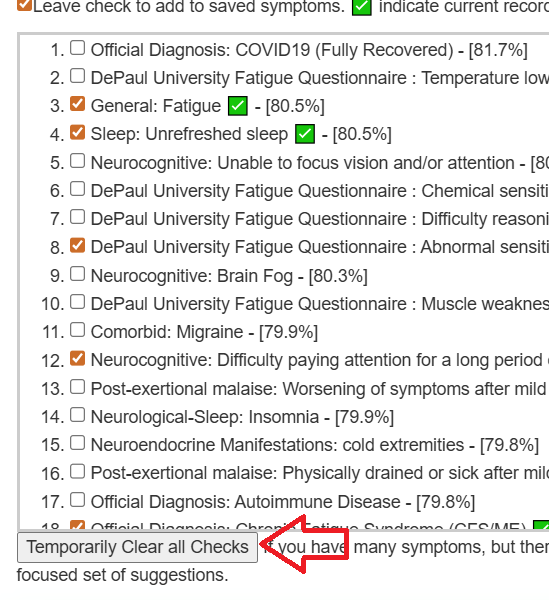
This is done the usual way but we temporarily clear all of the symptoms and then just marked this single symptom. We are wanting to focus solely on this one horrible symptom.

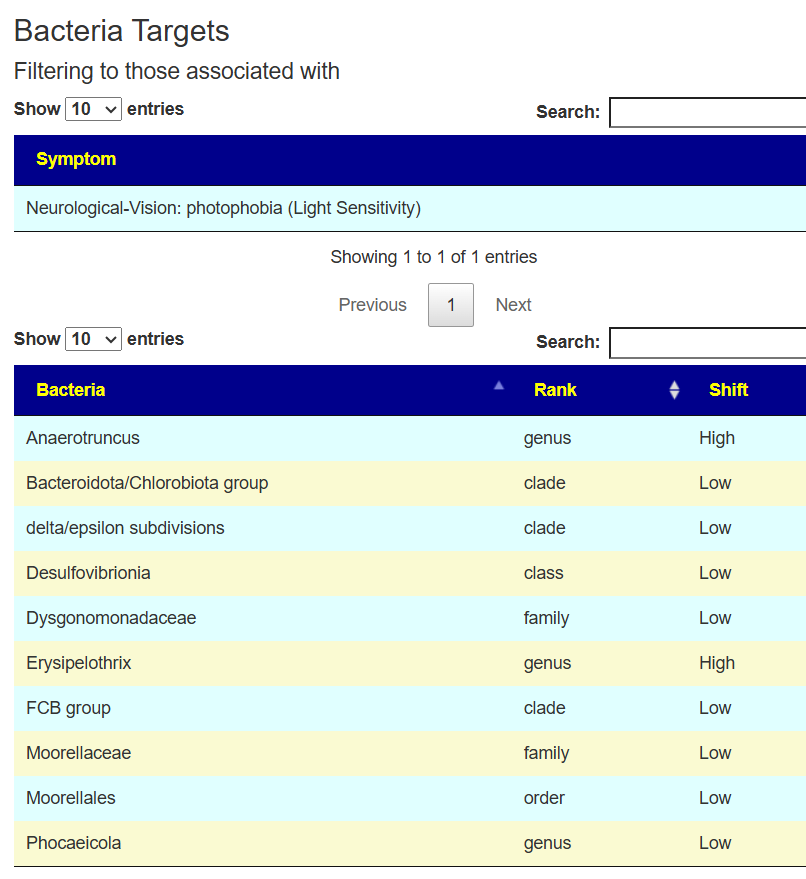
Clicking on this one symptom, we then get 10 bacteria associated

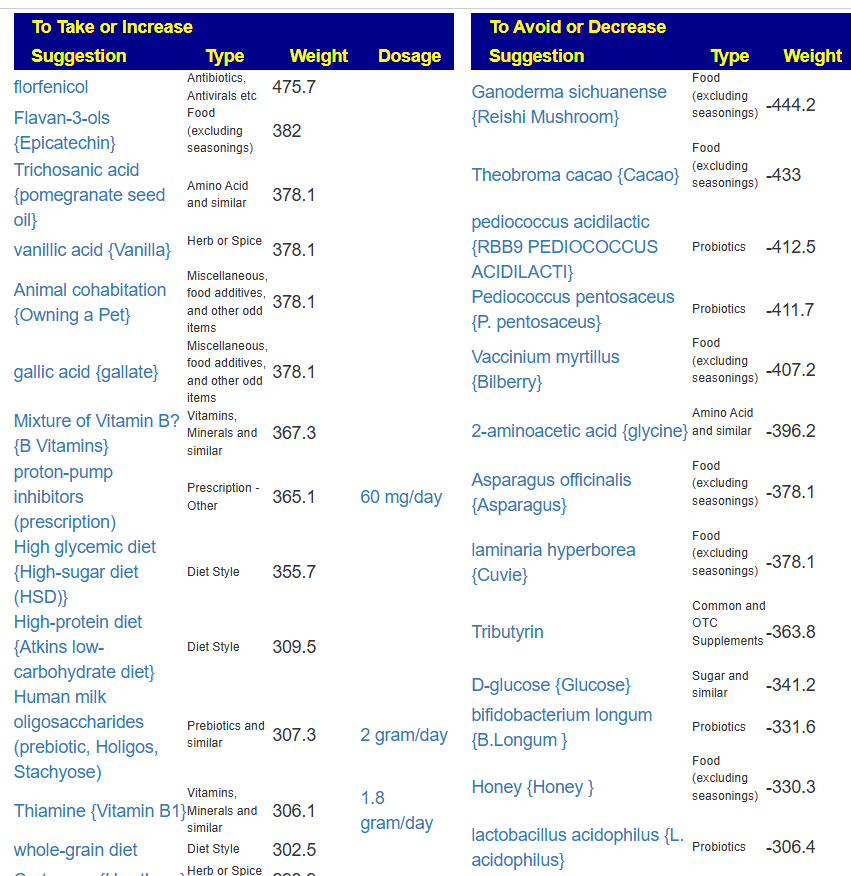
And also suggestions. I note some agreements between the methods:

  • Avoids: Honey, Ganoderma sichuanense {Reishi Mushroom},laminaria hyperborea {Cuvie}, etc
  • Takes: whole-grain diet, oligosaccharides
  • Disagreement: Bifidobacterium Longum – this gets interesting because the Odds Ratio indicate that the amount of Bifidobacterium Longum present was sufficient to reduce the odds to below 1.0

Summary

I generally favor a consensus of recommendations as the safest course. In this case, my impression is that using Odds Ratios leads to better identification of the bacteria involved (10 versus 24 for this sample), with the added benefit of indicating the relative importance of each bacterium. With Odds Ratios, the thresholds for being too high or too low are symptom-specific, rather than some magical universal cutoff that applies to all conditions.

Believing that there is one magic reference range for any bacteria is simply naive and ignoring the data.

I need to do some more refining of the code as well as enhancement to handle multiple symptoms concurrently; in time, this will be added to the sight.

Using Odds Ratio is now available on the site. The video below shows how to access it.

Technical Notes

Doing a low level comparison between the “classic forecast method” and the “Odds Ratio method I generated the table below. The Odds Ratio identified bacteria at a much more at a finer level (species) and most people would interpret that as being more targeted and likely better outcomes.

MeasureClassicOdds Ratio
Bacteria Considered115148
Bacteria in common2020
Species857
Genus2251
Family3321
Order2310
Class143

This also implies that only Genus and Species should be considered with Odds Ratio. Statistically this is preferred to reduce the amount of double counting.

Revisiting Suggestions using only Genus and Species with Odds Ratio

The R2 Probiotics are similar. Most probiotics are more challenging to obtain — see this page for known sources. The avoids are:

  • Lactobacillus johnsonii
  • Akkermansia muciniphila
  • Bacillus subtilis

Note: Pediococcus acidilactici and L.Plantarum (positive) mixtures is likely the easiest to obtain.

Tax_nameImpactPossible Source
Pediococcus acidilactici4.28Imagilin / NutriLots
Bacillus amyloliquefaciens group3.1only in big mixtures 🙁
Limosilactobacillus vaginalis1.79n/a
Bifidobacterium pseudocatenulatum1.6only in big mixtures 🙁
Leuconostoc mesenteroides1.6Bulk Probiotics / Leuconostoc Mesenteroides Probiotic Powder
Clostridium butyricum1.46Many sources
Lacticaseibacillus paracasei1.35danactive drink and many others
Lactococcus lactis1.33Bulk Probiotics / Lactococcus Lactis Probiotic Powder 
Bifidobacterium1.04

The To Take List

ModifierNetTakeAvoid
Slow digestible carbohydrates. {Low Glycemic}344712
dietary fiber294011
Fiber, total dietary233511
fruit203010
oligosaccharides {oligosaccharides}20244
High-fibre diet {Whole food diet}192910
fruit/legume fibre19289
whole-grain diet18245
(2->1)-beta-D-fructofuranan {Inulin}17181
bifidobacterium12120
Lactobacillus plantarum {L. plantarum}112211
wheat11121
3,3′,4′,5,7-pentahydroxyflavone {Quercetin}10111
Bovine Milk Products {Dairy}9134
Human milk oligosaccharides (prebiotic, Holigos, Stachyose)9101
polyphenols8124

The To Avoid List

high-fat diets-617
Honey {Honey }-516
Pulvis ledebouriellae compositae {Bofutsushosan}-405
2-aminoacetic acid {glycine}-404
laminaria hyperborea {Cuvie}-404
Vaccinium myrtillus {Bilberry}-404
D-glucose {Glucose}-416
Sodium Chloride {Salt}-415
Ferrum {Iron Supplements}-415
Ulmus rubra {slippery elm}-426
2-Amino-5-(carbamoylamino)pentanoic acid {Citrulline}-303
Lactotransferrin {Lactoferrin}-303
Sus domesticus {Pork}-303
Ganoderma sichuanense {Reishi Mushroom}-314
low protein diet-313
Theobroma cacao {Cacao}-325

Odds Ratio for the Microbiome 101

By Kenneth Lassesen, B.Sc.(Statistics), M.Sc.(Operations Research)

Odds Ratio and Chi2 are two sides of the same coin. The worth of this coin is far more than the fourrées seen with studies using averages.

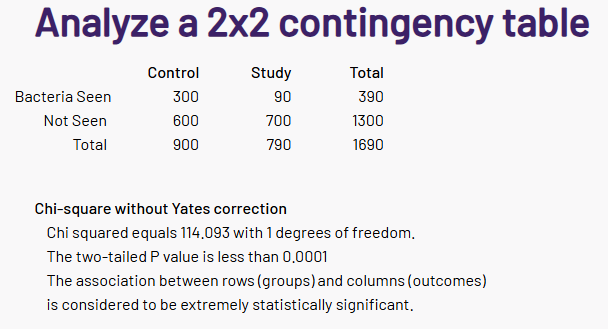
The simplest case is how often is a specific bacteria reported with the control versus study groups. This is easy computed and can be placed in a table such as the one below

Control (without Symptom)Study (or with Symptom)
Bacteria Seen30090
Bacteria Not Seen600700

Just looking at the table, it is obvious that this bacteria is less likely to be seen in a study group. We can just drop these numbers in a page like this one, and get the results.

Converting to odds ratio is simple:

  • Compute odds for study group30090=3.33390300=3.333.
  • Compute odds for control group6007000.857700600≈0.857.
  • Odds ratioOR=3.3330.8573.89 that seeing this bacteria put you likely not in the study group
    • Or 1/3.89 = 0.257 if seeing this bacteria, places you in the study group

Second Tier: The amount

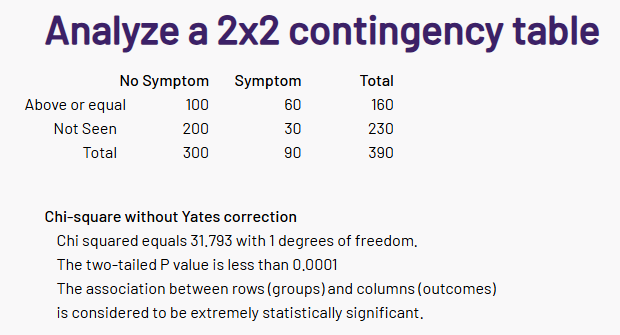
This is identical to the above, except there is a little mathematics needed to compute the best range of bacteria for odds ratio.

At 0.04%Control (without Symptom)Study (or with Symptom)
Above or Equal10060
Below20030

Again a simple computation with great statistical significant.

And again the Odds Ratio is calculated the same as above.

  • 100/60 = 1.66
  • 200/30 = 6.66
  • OR = 1.66 / 6.66 = 0.25 (or 4.00 for the reverse.

We have a tri-state odds ratio

  • Bacteria not seen: 0.257 of having symptom (i.e. bacteria is rarely seen with symptom)
  • Bacteria see but above or equals to 0.04%: 3.89 * 4 =15.56
  • Bacteria see but below 0.04%: 3.89 * .25 = 0.9725, almost no effect.

In this example, we used above or below 0.04%; we could have also used in the range (0.03 to 0.07) or not in the range.

Key points

  • Use only bacteria with P < 0.001 or better
    • Check Present or not Present
    • There is a finite enumeration of possible ranges when a bacteria present.
      • With today’s powerful computers, this is not a challenge
  • Check all bacteria that satisfies the minimum size constraint for the function used for the 2×2 table

For some symptoms we have:

  • over 450 bacteria with significant odds ratios for some conditions.
  • Highest Odds ratio over 92 for some bacteria

Performance

This data is based on self-declared symptoms from users. Often the symptoms entered are incomplete (some users had over 100 symptoms entered). While not rigorous, this appears to work for getting sample annotations entered in a citizen science context and for demonstration of the concept. There was enough consistency of data to get results.

The best news: The following had the Odds Ratio > 1.0, over a dozen in the sampling and agreement with entered symptoms.

SourceSymptomNameAccurate %
BiomeSightOfficial Diagnosis: Mood Disorders100
ThryveDePaul University Fatigue Questionnaire : Frequently get words or numbers in the wrong order100
ThryveAutism: More Repetitive Movements100
ThryveAutonomic Manifestations: cardiac arrhythmias100
ThryveCondition: Acne100
ThryveDePaul University Fatigue Questionnaire : Pain in Multiple Joints without Swelling or Redness100
ThryveDePaul University Fatigue Questionnaire : Feeling like you have a temperature100
ThryveOfficial Diagnosis: Diabetes Type 1100
ThryveNeurological: Spatial instability and disorientation100
ThryveCondition: Type 1 Diabetes100
ThryveNeuroendocrine Manifestations: abnormal appetite100
BiomeSightAutonomic Manifestations: delayed postural hypotension100
ThryvePhysical: Long term antibiotics(over 6 months)100
ThryveComorbid: Electromagnetic Sensitivity (EMF)100
BiomeSightPhysical: Bad Air Quality100
BiomeSightNeuroendocrine Manifestations: marked diurnal fluctuation100
ThryvePhysical: Amalgam fillings100
BiomeSightComorbid: Reactive Hypoglicemia100
ThryveComorbid: Sugars cause sleep or cognitive issues100
BiomeSightOfficial Diagnosis: Dermatitis (all types)100
ThryvePhysical: Steps Per Day 2000-4000100
ThryveNeuroendocrine Manifestations: Painful menstrual periods100
ThryveGeneral: Anhedonia (inability to feel pleasure)100
BiomeSightVirus: Parvovirus positive (B19)100
BiomeSightBlood Type: FUT2 secretor100
ThryveOfficial Diagnosis: High Blood Pressure (Hypertension)100
ThryveDePaul University Fatigue Questionnaire : Poor hand to eye coodination100
ThryveInfection: Coxsackie100
ThryveNeuroendocrine Manifestations: marked diurnal fluctuation100

Looking at the biggest sets. we see very good performance for some symptoms and poor performance for items like gender. Unrefreshing Sleep is interesting:

  • Unrefreshed sleep: 88.6% accurate
  • Unrefreshing Sleep, that is waking up feeling tired: 36.7% accurate

Is the cause, the fineness of definition (and lack of clarity by users entering) or some other issues?

SourceSymptom% CorrectSize
BiomeSightGeneral: Fatigue98.70317694
BiomeSightNeurocognitive: Brain Fog98.18182660
BiomeSightSleep: Unrefreshed sleep88.57616604
BiomeSightNeurocognitive: Difficulty paying attention for a long period of time75.54113462
BiomeSightImmune Manifestations: Bloating90.13761436
BiomeSightDePaul University Fatigue Questionnaire : Fatigue85.96491399
BiomeSightGender: Male59.79644393
BiomeSightComorbid: Histamine or Mast Cell issues88.0102392
BiomeSightOfficial Diagnosis: COVID19 (Long Hauler)97.87798377
BiomeSightDePaul University Fatigue Questionnaire : Unrefreshing Sleep, that is waking up feeling tired36.66667360
BiomeSightNeurocognitive: Can only focus on one thing at a time63.76404356
BiomeSightNeuroendocrine Manifestations: worsening of symptoms with stress.70.26239343
BiomeSightNeurological-Audio: Tinnitus (ringing in ear)60.71429336
BiomeSightNeurocognitive: Problems remembering things47.00599334
BiomeSightAge: 30-4097.14286315
BiomeSightDePaul University Fatigue Questionnaire : Post-exertional malaise, feeling worse after doing activities that require either physical or mental exertion92.33227313
BiomeSightNeurocognitive: Absent-mindedness or forgetfulness62.7907301
BiomeSightSleep: Daytime drowsiness69.33333300
BiomeSightPost-exertional malaise: General85.95318299
BiomeSightImmune Manifestations: Constipation83.22148298

Lab Performance

Identification by Age exhibits the reality of all labs are not equal. If Odds Ratios from the microbiome was not statistically significant for estimating age, we would see 14% for accuracy. We far exceed that.

LabSymptomAccuracySize
BiomeSightAge: 0-1086.229
OmbreAge: 0-1076.359
BiomeSightAge: 10-208025
OmbreAge: 10-2094.719
BiomeSightAge: 20-3058.5135
OmbreAge: 20-3064.734
BiomeSightAge: 30-4097.1315
OmbreAge: 30-4066.3104
BiomeSightAge: 40-5022.2203
OmbreAge: 40-5071.463
BiomeSightAge: 50-6029.7111
OmbreAge: 50-6061.747
BiomeSightAge: 60-7052.559
OmbreAge: 60-7018.183
BiomeSightAge: 70-809020

This difference of labs is seen with other symptoms — some of which has associations reported in the literature.

SourceSymptomNameRatioSize
BiomeSightGeneral: Depression67.7195
OmbreGeneral: Depression13.9108
BiomeSightGeneral: Fatigue98.7694
OmbreGeneral: Fatigue20.8149
BiomeSightGeneral: Headaches71.6197
OmbreGeneral: Headaches15.5103

Summary

The use of odds ratios provides statistically significant evidence for identifying probable symptoms. While not definitive—acknowledging that few diagnostic tests achieve complete certainty—the results demonstrate that both the selected testing method and its interpretation (for example, in relation to bacterial associations) materially influence diagnostic accuracy.

In clinical contexts, reliance on odds ratios offers greater methodological rigor than studies reporting merely “higher or lower levels of certain bacteria with P<0.05.” A notable clinical strength of this approach lies in its capacity to generate a structured list of potential symptoms for further inquiry, including those that patients may not have initially disclosed.

Nota Bene: It should be noted that the observed error rate is likely attributable, at least in part, to underreporting of symptoms. Patients often disclose only the symptoms they perceive as most severe, thereby introducing reporting bias into the dataset.

The table below shows the accuracy from 4 different labs. It is not a surprise that Shotgun data is more accurate than 16s tests.

SourceRatioSize
BiomeSight – 16s60.845069
Thorne – Shotgun80.7491
Ombre/Thryve – 16s40.817123
uBiome – 16s47.613071

Symptom Forecasts – 2 methods

I just pushed a new feature that is shown in the video below

The differences of the two methods are:

  • Old method looks at the level of bacteria that you have only. This is ideal for making suggestions because we want to alter what is there.
  • New, Odds Ratio method, looks at which bacteria were found (or missing) and their levels. Addressing missing bacteria is not trivial — unless it is a known probiotics species (99% are not)

Odds Ratio is likely more accurate because it considers what is there, the amount and what is missing. It is not an ideal choice for computing suggestions.

Remember Odds Ratios do not say you will have a symptom, it merely indicates increased odds of having the symptom.

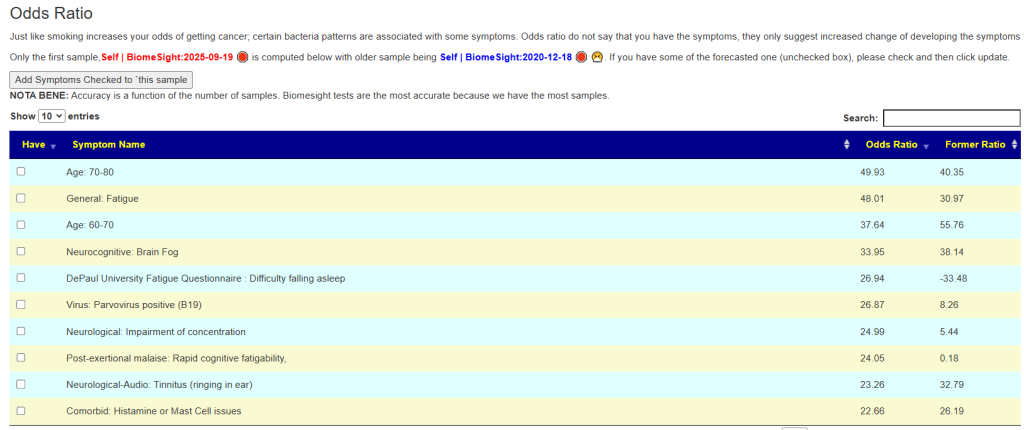
Example below of two samples taken 5 years apart. Earlier sample, patient was 68, later sample 73. In general reflects well the symptoms reported.

Probiotics Suggestions Update

For many months, using R2 Associations to select probiotics used a generic database from PrecisionBiome. Over the year end holidays, I computed the R2 Associations based on data from specific labs. This is far more accurate and have just been added for the following labs:

  • Biomesight (best because biggest dataset)
  • Ombre
  • uBiome
  • Thorne (smallest dataset and not as much data).

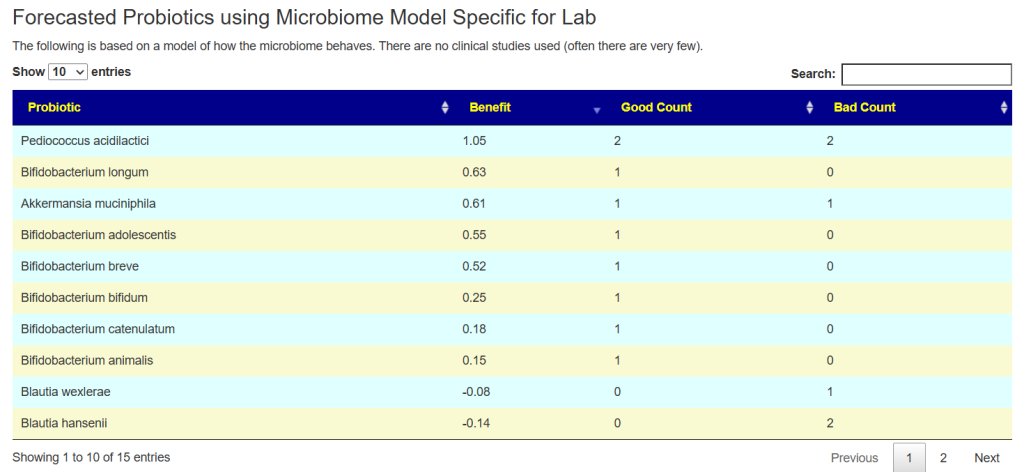
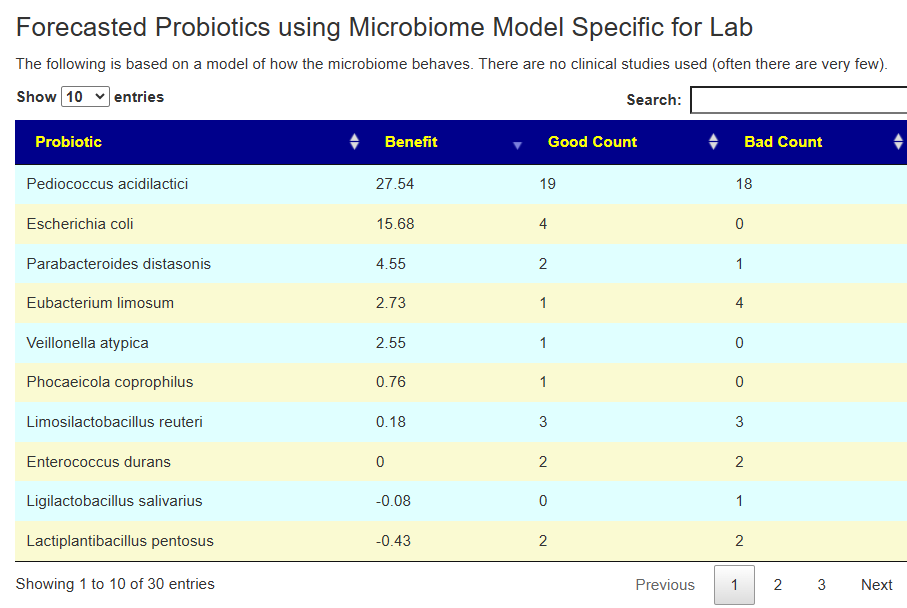
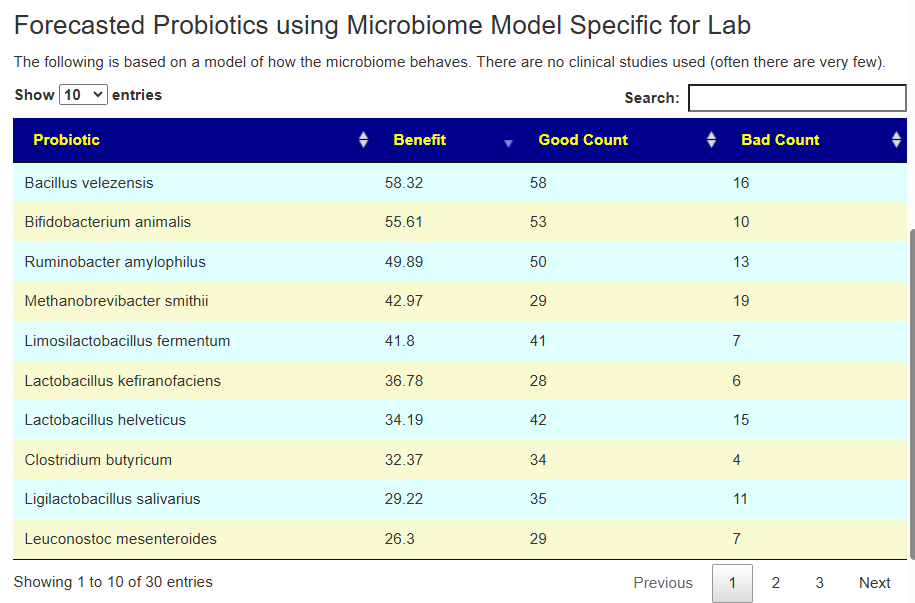
At the bottom of the suggestion page you will see a new section like below:

The range of numbers can vary greatly.

Which is best? We have multiple ways of computing probiotics. The ideal would be to do only ones that each way advocates. When there are Good and Bad counts, having a positive good and zero for bad is ideal.

The reality is that this rarely happens. I tend to favor Good count much bigger than Bad with a high positive benefit. Our knowledge is sparse and often studies results fail to duplicate. I tend to favor this method because it is an Fuji apple to Fuji apple comparison instead of the Crab Apple to Watermelon comparison that published studies tend to be.

A new Probiotics Source

A reader forwarded a Bulgaria supplier site to me. I was delighted to see their offerings!

Probiotics availability is a complex area with national laws restricting access. A good example is the US: if you are not producing a grandfathered species then there is a massive amount of testing to get approved for sale. A good example is Mutaflor, E.Coli Nissle 1917, which cannot be sold in the US despite a literal century of safe use in Europe.

This is further complicated because a probiotic claiming to be a specific species may be tested and depending on the test used be found to not be there, a different species or as claimed. There is no standardization of microbiome testing See this post for the background.

In most of Western Countries, there is a huge profit margin for probiotics, 10x or 20x the cost of production is not unusual. Often manufacturers will often prevent the import of foreign probiotics citing safety or lack of “in country safety tests”. Some people may find that they cannot import those below.

Bottom line: I take claims of species in a probiotic on face value. See bottom on selecting probiotics given a microbiome sample; most of these have very few clinical studies in English. I will be adding these to the probiotic search page over the next week.

The predicted / model impact of each probiotic above can be estimated from this page.

Over the next week, I will attempt to add modelled impact on each of these combinations on a microbiome sample using the link below on the suggestions page.