Microbiome Odds Ratios for Light Sensitivity

I just got an email asking for which bacteria are involved with Light Sensitivity. This post is just presenting the tables derived from the methodology described in this technical post: Odds Ratios and the Microbiome

Here are some odds ratios using BiomeSight data. Odds Low means when the reading is below the Median and Odds High above the Median (of those with this symptom). We use the symptom median to get balanced (same approximate size) categories. Using an average results in poorer results.

A 1.2 in Odds Low, means that having less then typical/median increases your odds, i.e. you want to increase the amount.

Neurological-Vision: photophobia (Light Sensitivity)

At first look for probiotics (i.e. Odds Low over 1, too low), we see:

  • Bifidobacterium longum
  • Bifidobacterium breve
  • Bifidobacterium adolescentis
Tax_Nametax_RankOdds LowOdd High
Desulfovibrio fairfieldensisspecies0.701.75
Luteolibactergenus0.731.72
Finegoldia magnaspecies0.711.71
Luteolibacter algaespecies0.731.71
Finegoldiagenus0.711.71
Anaerotruncus colihominisspecies0.721.68
Anaerotruncusgenus0.721.67
Oscillatorialesorder0.751.66
Anaerococcusgenus0.731.66
Desulfitobacteriaceaefamily1.630.66
Bifidobacterium indicumspecies1.600.67
Geobacillusgenus0.741.58
Rubritaleagenus0.751.58
Rubritaleaceaefamily0.751.58
Desulfosporosinusgenus1.550.66
Eggerthella sinensisspecies0.771.53
Prevotella biviaspecies0.751.52
Peptoniphilus asaccharolyticusspecies0.751.51
Aerococcaceaefamily0.781.51
Streptococcus anginosus groupspecies group0.761.47
Bifidobacterium longumspecies1.470.75
Bacteroides salyersiaespecies1.450.76
Ethanoligenensgenus0.781.44
Coprococcusgenus1.430.77
Oscillatoriaceaefamily0.781.43
Veillonella atypicaspecies1.420.71
Catenibacteriumgenus1.420.64
Mogibacteriumgenus0.781.42
Eubacteriales Family XIII. Incertae Sedisfamily0.781.42
Thermoanaerobactergenus1.410.75
Prevotella aurantiacaspecies0.791.40
Bifidobacteriumgenus1.400.78
Bifidobacterium gallicumspecies1.390.77
Lachnobacteriumgenus1.380.78
Bifidobacteriaceaefamily1.380.78
Bifidobacterialesorder1.380.78
Moorellaceaefamily1.380.74
Moorellagenus1.380.74
Moorellalesorder1.380.74
Bifidobacterium subtilespecies1.380.72
Ectothiorhodospiraceaefamily0.791.38
Filifactorgenus0.791.37
Pectinatus cerevisiiphilusspecies1.350.77
Chloroflexotaphylum1.340.79
Sarcina maximaspecies1.330.79
Oribacteriumgenus1.320.80
Alkalithermobacter thermoalcaliphilusspecies1.310.73
Clostridium cadaverisspecies1.310.79
Oribacterium sinusspecies1.310.81
Enterobactergenus1.310.81
Bifidobacterium choerinumspecies1.310.81
Veillonella parvulaspecies1.310.77
Bifidobacterium brevespecies1.300.78
Natronincolagenus1.300.81
Ruminococcus albusspecies1.300.81
Eukaryotasuperkingdom1.290.71
Faecalibacteriumgenus1.290.81
Faecalibacterium prausnitziispecies1.290.82
Thermoclostridiumgenus1.290.81
Thermosediminibacteralesorder1.290.79
Rivulariaceaefamily1.270.82
Devosiagenus1.260.62
Devosiaceaefamily1.260.62
Desulfuromonadiaclass1.260.83
Desulfuromonadalesorder1.260.83
Thermoclostridium caenicolaspecies1.260.83
Negativicoccus succinicivoransspecies1.260.81
Ruminococcus callidusspecies1.250.81
Desulfuromonadaceaefamily1.240.83
Actinomycetotaphylum1.240.84
Anaerostipesgenus1.240.84
Coprococcus eutactusspecies1.230.84
Peptostreptococcaceae incertae sedisno rank1.230.81
Caloramator indicusspecies1.230.83
Pectinatusgenus1.230.83
Mycoplasmopsis edwardiispecies1.230.76
Holdemanella biformisspecies1.230.82
Holdemanellagenus1.230.82
Opisthokontaclade1.230.69
Eumetazoaclade1.230.69
Metazoakingdom1.230.69
Lachnospiragenus1.230.84
Streptococcus millerispecies1.230.77
Tepidanaerobactergenus1.230.83
Tepidanaerobacter syntrophicusspecies1.230.83
Tepidanaerobacteraceaefamily1.230.83
Calothrixgenus1.220.76
Calotrichaceaefamily1.220.76
Natranaerobialesorder1.220.85
Bifidobacterium adolescentisspecies1.220.85
Leuconostocaceaefamily1.220.83
Heliorestisgenus1.220.84
Pasteurellaceaefamily1.220.84
Pasteurellalesorder1.220.84
Dyadobactergenus1.220.70
Paenibacillusgenus1.220.72
Bilateriaclade1.220.69
Anaerolineaeclass1.220.84
Acidaminococcus fermentansspecies1.220.84
Proteinivoraceaefamily1.220.84
Anaerobrancagenus1.220.84
Anaerobranca zavarziniispecies1.220.84
Protostomiaclade1.220.70
Syntrophomonadaceaefamily1.210.84
Coprobacillus cateniformisspecies1.210.85
Mesoplasma entomophilumspecies1.210.85
Moorella groupnorank1.210.85
Aeromonadalesorder1.210.84
Streptococcus parasanguinisspecies1.200.82
Mollicutesclass1.200.85
Mycoplasmatotaphylum1.200.85
Devosiagenus1.200.71
Devosiaceaefamily1.200.71
Salisaeta longaspecies1.200.66
Ectothiorhodospiragenus1.200.62
Paraburkholderia phenoliruptrixspecies1.200.80
Deferribacter autotrophicusspecies1.200.38
Candidatus Phytoplasmagenus1.200.84

DePaul Fatigue Questionnaire : Abnormal sensitivity to light

At first look for probiotics (i.e. Odds Low over 1, too low), we see:

  • Bifidobacterium longum
  • Bifidobacterium adolescentis
Tax_Nametax_RankOdds LowOdd High
Anaerotruncus colihominisspecies0.691.79
Erysipelothrixgenus0.721.68
Erysipelothrix murisspecies0.721.67
Anaerotruncusgenus0.721.67
Bifidobacterialesorder1.660.71
Bifidobacteriaceaefamily1.660.71
Bifidobacterium longumspecies1.650.71
Prevotella biviaspecies0.721.63
Bifidobacteriumgenus1.620.72
Bifidobacterium adolescentis JCM 15918strain1.620.70
Desulfonatronum thiosulfatophilumspecies0.731.59
Desulfonatronaceaefamily0.731.59
Desulfonatronumgenus0.731.59
Prevotella disiensspecies0.741.58
Desulfitobacteriaceaefamily1.560.70
Bifidobacterium choerinumspecies1.540.71
Bifidobacterium adolescentisspecies1.540.73
Heliorestisgenus1.520.74
Bacteroides salyersiaespecies1.520.73
Holdemaniagenus0.751.49
Eubacteriales Family XIII. Incertae Sedisfamily0.751.49
Mogibacteriumgenus0.751.49
Bifidobacterium subtilespecies1.490.64
Rubritaleagenus0.791.48
Rubritaleaceaefamily0.791.48
Bifidobacterium indicumspecies1.470.74
Erwiniaceaefamily0.781.47
Erwiniagenus0.781.47
Bacteroides eggerthiispecies1.440.69
Phocaeicola coprophilusspecies1.430.65
Desulfosporosinusgenus1.430.73
Oscillatorialesorder0.791.43
Catenibacteriumgenus1.420.64
Peptoniphilus asaccharolyticusspecies0.781.42
Chloroflexotaphylum1.420.75
Lachnobacteriumgenus1.410.76
Dyadobactergenus1.410.44
Bifidobacterium gallicumspecies1.410.76
Bilophilagenus0.781.40
Actinomycetesclass1.390.78
Luteolibacter algaespecies0.791.39
Veillonella parvulaspecies1.390.72
Amedibacillus dolichusspecies0.791.39
Amedibacillusgenus0.791.38
Hymenobacter xinjiangensisspecies0.801.38
Actinomycetotaphylum1.370.78
Butyricimonasgenus0.791.36
Oxalobacter formigenesspecies0.801.36
Anaerofilumgenus0.801.34
Salinicoccus luteusspecies1.340.74
Devosiagenus1.330.52
Devosiaceaefamily1.330.52
Natronincolagenus1.320.80
Heliobacteriaceaefamily1.310.81
Lactococcusgenus1.290.81
Alkalithermobacter thermoalcaliphilusspecies1.290.75
Oribacteriumgenus1.290.81
Coprococcus eutactusspecies1.290.80
Phocaeicola massiliensisspecies1.280.82
Streptococcus fryispecies1.280.75
Aeromonadalesorder1.280.78
Insolitispirillumgenus1.270.82
Insolitispirillum peregrinumspecies1.270.82
Aedoeadaptatus coxiispecies1.270.82
Hyphomicrobiaceaefamily1.270.79
Salinicoccusgenus1.260.80
Oribacterium sinusspecies1.260.82
Clostridium cadaverisspecies1.260.82
Streptococcus anginosus groupspecies group1.260.82
Novispirillumgenus1.260.83
Caloramator indicusspecies1.260.82
Clostridium malenominatumspecies1.250.70
Ruminococcus callidusspecies1.250.81
Moorellaceaefamily1.250.83
Moorellagenus1.250.83
Moorellalesorder1.250.83
Clostridium frigorisspecies1.240.83
Collinsellagenus1.240.83
Pasteurellaceaefamily1.240.84
Pasteurellalesorder1.240.84
Ruminiclostridium cellulolyticumspecies1.240.82
Veillonella atypicaspecies1.240.79
Anaerolineaeclass1.230.83
Collinsella aerofaciensspecies1.230.84
Legionellaceaefamily1.230.83
Legionellagenus1.230.84
Rhodanobacteraceaefamily1.230.83
Sutterella stercoricanisspecies1.230.84
Atopobiumgenus1.230.81
Legionellalesorder1.220.85
Metazoakingdom1.220.70
Eumetazoaclade1.220.70
Opisthokontaclade1.220.70
Bacteroides heparinolyticusspecies1.210.79
Desulfovibriogenus1.210.84
Segatellagenus1.210.84
Bilateriaclade1.210.71
Pediococcusgenus1.210.81
Protostomiaclade1.200.71
Eukaryotasuperkingdom1.200.80
Streptococcus infantisspecies1.200.80
Faecalibacterium prausnitziispecies1.200.86
Bacteroidotaphylum1.200.86

Microbiome Odds Ratios for Mast Cells and Histamine issues

I just got an email asking for which bacteria are involved with Mast Cells and Histamine issues. This post is just presenting the tables derived from the methodology described in this technical post: Odds Ratios and the Microbiome. We do not have sufficient data for Mast Cell Activation Syndrome (MCAS)

Here are some odds ratios using BiomeSight data. Odds Low means when the reading is below the Median and Odds High above the Median (of those with this symptom). We use the symptom median to get balanced (same approximate size) categories. Using an average results in poorer results.

A 1.2 in Odds Low, means that having less then typical/median increases your odds, i.e. you want to increase the amount.

Official Diagnosis: Mast Cell Dysfunction

At first look for probiotics (i.e. Odds Low over 1, too low), we see:

  • Akkermansia muciniphila
  • Lactococcus
Tax_Nametax_RankOdds LowOdd High
Sharpeagenus0.731.67
Sharpea azabuensisspecies0.731.66
Haemophilusgenus1.580.69
Haemophilus parainfluenzaespecies1.570.70
Pasteurellalesorder1.540.74
Pasteurellaceaefamily1.540.74
Veillonella atypicaspecies1.530.63
[Ruminococcus] torquesspecies0.751.49
Erysipelothrix murisspecies0.761.49
Amedibacillus dolichusspecies0.761.48
Amedibacillusgenus0.761.48
Lactococcusgenus1.480.70
Erysipelothrixgenus0.771.48
Syntrophobacteralesorder0.771.45
Syntrophobacteriaclass0.771.45
Holdemaniagenus0.771.43
Turicibactergenus1.420.77
Turicibacteraceaefamily1.420.77
Alkaliphilus crotonatoxidansspecies1.410.77
Chloroflexotaphylum1.410.75
Slackiagenus1.400.77
Serratia entomophilaspecies0.781.40
Yersiniaceaefamily0.791.38
Limnobactergenus0.791.38
Limnobacter litoralisspecies0.791.38
Holdemanellagenus1.370.77
Holdemanella biformisspecies1.370.77
Thermodesulfobacteriotaphylum1.360.79
Ruminiclostridium cellobioparum subsp. termitidissubspecies1.360.79
Ruminiclostridium cellobioparumspecies1.360.79
Alkaliphilusgenus1.360.78
Sutterella sanguinusspecies1.350.78
Akkermansiaceaefamily1.350.78
Ruminococcus albusspecies1.350.79
Akkermansiagenus1.350.78
Akkermansia muciniphilaspecies1.350.78
Anaerolineaeclass1.340.75
Desulfuromonadiaclass1.340.78
Desulfuromonadalesorder1.340.78
Parabacteroides merdaespecies1.330.80
PVC groupclade1.330.80
Rhodanobacteraceaefamily1.330.79
Verrucomicrobiotaphylum1.330.80
Sphingobacteriumgenus1.310.81
Oribacteriumgenus1.300.81
Veillonella disparspecies1.300.77
Ruminiclostridiumgenus1.300.80
Oribacterium sinusspecies1.290.82
Odoribactergenus1.280.82
Verrucomicrobiaceaefamily1.280.82
Verrucomicrobiiaclass1.280.82
Desulfuromonadaceaefamily1.280.81
Verrucomicrobialesorder1.270.82
Streptococcaceaefamily1.270.82
Clostridium taeniosporumspecies1.260.79
Flavobacteriiaclass1.260.82
Flavobacteriaceaefamily1.260.82
Flavobacterialesorder1.260.82
Sutterella wadsworthensisspecies1.260.81
delta/epsilon subdivisionsclade1.250.83
Lysobacteralesorder1.250.83
Heliobacteriaceaefamily1.250.77
Streptococcus thermophilusspecies1.240.82
Deltaproteobacteriaclass1.240.83
Gillisiagenus1.240.83
Actinomycetotaphylum1.240.84
Actinobacillusgenus1.240.84
Sutterella stercoricanisspecies1.240.83
Gillisia limnaeaspecies1.230.84
Phocaeicola plebeiusspecies1.230.75
Bacteroides stercorisspecies1.220.85
Streptococcusgenus1.220.84
Alcaligenaceaefamily1.210.85
Desulfovibrioniaclass1.210.85
Desulfovibrionalesorder1.210.85
Sutterellagenus1.210.85
Sutterellaceaefamily1.210.85
Mitsuokellagenus1.210.77
Actinomycetalesorder1.210.83
Betaproteobacteriaclass1.200.85
Rhodothermaceaefamily1.200.84
Anaerobranca zavarziniispecies1.200.85
Anaerobrancagenus1.200.85
Proteinivoraceaefamily1.200.85

Comorbid: Histamine or Mast Cell issues

This is a little more fuzzy for the criteria. With too low levels being very common but not as common as seen with Odds Ratios for Neurological-Audio: hypersensitivity to noise

At first look for probiotics (i.e. Odds Low over 1, too low), we see:

Tax_Nametax_RankOdds LowOdd High
Bifidobacterium angulatumspecies1.960.58
Sphingobiumgenus1.730.63
Vagococcus teuberispecies1.690.70
Catenibacterium mitsuokaispecies1.650.52
Polyangiasubclass1.580.65
Segatella paludivivensspecies1.560.73
Hoylesella loescheiispecies1.540.64
Filifactor villosusspecies0.781.54
Myxococcotaphylum1.540.59
Myxococcalesorder1.540.59
Myxococciaclass1.540.59
Aggregatibactergenus1.480.76
Luteolibactergenus0.771.42
Azospirillumgenus1.420.64
Luteolibacter algaespecies0.781.41
Bilophilagenus0.781.41
Actinobacillus pleuropneumoniaespecies1.390.69
Acetobacteraceaefamily1.380.72
Catenibacteriumgenus1.380.68
Caldilineaeclass1.370.76
Caldilineaceaefamily1.370.76
Caldilinea tarbellicaspecies1.370.76
Caldilinealesorder1.370.76
Caldilineagenus1.370.76
Bilophila wadsworthiaspecies0.791.36
Sutterella stercoricanisspecies1.350.76
Actinomycetotaphylum1.340.80
Bifidobacterium dentiumspecies1.330.80
Bacteroides salyersiaespecies1.330.80
Ruminococcus callidusspecies1.320.80
Schaaliagenus1.320.78
Prevotella dentasinispecies1.310.80
Actinomycetesclass1.310.81
Schaalia naturaespecies1.310.63
Brachybacteriumgenus1.310.41
Anaerolineaeclass1.300.79
Bifidobacteriaceaefamily1.300.81
Bifidobacterialesorder1.300.81
Desulfovibrio simplexspecies1.300.81
Thermosediminibacteralesorder1.290.79
Bifidobacteriumgenus1.290.82
Oribacteriumgenus1.290.82
Turicibacteraceaefamily1.280.82
Turicibactergenus1.280.82
Tepidibactergenus1.280.75
Alishewanellagenus1.280.55
Candidatus Tammella caduceiaespecies1.270.72
Candidatus Tammellagenus1.270.72
Oribacterium sinusspecies1.270.82
Mannheimiagenus1.270.82
Mesoplasma entomophilumspecies1.270.81
Coprococcus eutactusspecies1.260.83
Heliorestisgenus1.250.82
Chloroflexotaphylum1.250.77
Luteibacter anthropispecies1.250.83
Streptococcus sanguinisspecies1.250.74
Neisserialesorder1.250.78
Tepidanaerobacteraceaefamily1.250.82
Tepidanaerobacter syntrophicusspecies1.250.82
Tepidanaerobactergenus1.250.82
Mannheimia caviaespecies1.240.82
Luteibactergenus1.240.84
Holdemanella biformisspecies1.240.81
Holdemanellagenus1.240.81
Entomoplasmataceaefamily1.240.83
Entomoplasmatalesorder1.240.83
Mesoplasmagenus1.240.83
Anaeroplasmagenus1.240.82
Anaeroplasmatalesorder1.240.82
Anaeroplasmataceaefamily1.240.82
Succinivibrionaceaefamily1.240.80
Natranaerobialesorder1.240.84
Coraliomargarita akajimensisspecies1.240.62
Coraliomargaritaceaefamily1.240.62
Coraliomargaritagenus1.240.62
Schaalia odontolyticaspecies1.240.76
Chroococcus minutusspecies1.240.80
Chroococcusgenus1.240.80
Chroococcaceaefamily1.240.80
Morganellaceaefamily1.240.74
Ligilactobacillusgenus1.240.76
Sphingomonasgenus1.230.58
Anaerobrancagenus1.230.83
Anaerobranca zavarziniispecies1.230.83
Proteinivoraceaefamily1.230.83
Helicobacteraceaefamily1.230.65
Dermabacteraceaefamily1.230.63
Syntrophomonadaceaefamily1.230.84
Helicobactergenus1.230.65
Lactococcus lactisspecies1.230.84
Slackiagenus1.230.84
Sutterella sanguinusspecies1.230.84
Streptococcus infantisspecies1.220.79
Sporotomaculumgenus1.220.81
Desulfallaceaefamily1.220.81
Streptococcus oralisspecies1.220.78
Bifidobacterium longumspecies1.220.85
Lactococcusgenus1.220.84
Bifidobacterium asteroidesspecies1.210.79
Succinivibriogenus1.210.83
Coprococcusgenus1.210.85
Bifidobacterium adolescentisspecies1.210.84
Segatella albensisspecies1.210.83
Geobacillusgenus1.210.77
Lachnobacteriumgenus1.210.85
Deferribactergenus1.210.37
Salisaetagenus1.210.66
Salisaetaceaefamily1.210.66
Atopobium fossorspecies1.200.72
Mollicutesclass1.200.85
Mycoplasmatotaphylum1.200.85
Devosiagenus1.200.71
Devosiaceaefamily1.200.71
Salisaeta longaspecies1.200.66
Ectothiorhodospiragenus1.200.62
Paraburkholderia phenoliruptrixspecies1.200.80
Deferribacter autotrophicusspecies1.200.38
Candidatus Phytoplasmagenus1.200.84

Odds Ratios for Neurological-Audio: hypersensitivity to noise

I just got an email asking for which bacteria are involved with hypersensitivity to noise. This post is just presenting the tables derived from the methodology described in this technical post: Odds Ratios and the Microbiome

Here are some odds ratios using BiomeSight data. Odds Low means when the reading is below the Median and Odds High above the Median (of those with this symptom). We use the symptom median to get balanced (same approximate size) categories. Using an average results in poorer results.

A 1.2 in Odds Low, means that having less then typical/median increases your odds, i.e. you want to increase the amount.

At first look for probiotics, we see:

  • Bifidobacterium adolescentis
  • Bifidobacterium longum
  • Lactococcus

I also note that Odds Low really dominant, i.e. too little of a lot of different bacteria. This hints at Prescript-Assist®/SBO Probiotic with 22 different unusual probiotics as being a possible candidate as well as General Biotics/Equilibrium.

Tax_Nametax_RankOdds LowOdd High
Collinsella tanakaeispecies0.741.67
Segatella paludivivensspecies1.560.73
Viridiplantaekingdom1.510.65
Peptostreptococcus stomatisspecies1.470.69
Bacteroides salyersiaespecies1.420.74
Neisserialesorder1.420.63
Bifidobacteriumgenus1.420.77
Bifidobacterium adolescentisspecies1.410.76
Bifidobacterialesorder1.410.77
Bifidobacteriaceaefamily1.410.77
genistoids sensu latoclade1.400.72
rosidsclade1.400.72
Rothiagenus1.400.72
core genistoidsclade1.400.72
Crotalarieaetribe1.400.72
Fabaceaefamily1.400.72
Papilionoideaesubfamily1.400.72
50 kb inversion cladeclade1.400.72
Fabalesorder1.400.72
fabidsclade1.400.72
Desulfosporosinusgenus1.390.76
Gunneridaeclade1.390.73
Streptophytinasubphylum1.390.73
Tracheophytaclade1.390.73
Embryophytaclade1.390.73
eudicotyledonsclade1.390.73
Spermatophytaclade1.390.73
Magnoliopsidaclass1.390.73
Mesangiospermaeclade1.390.73
Euphyllophytaclade1.390.73
Streptophytaphylum1.390.73
Pentapetalaeclade1.390.73
Bifidobacterium choerinumspecies1.380.77
Neisseriagenus1.380.67
Bifidobacterium adolescentis JCM 15918strain1.370.79
Lysobactergenus0.791.37
Neisseriaceaefamily1.370.65
Rothiagenus1.360.75
Actinomycetotaphylum1.360.79
Bifidobacterium gallicumspecies1.350.75
Catenibacterium mitsuokaispecies1.350.72
Planococcusgenus1.340.57
Bifidobacterium indicumspecies1.340.75
Planococcus columbaespecies1.340.58
Enterobactergenus1.340.80
Morganellaceaefamily1.330.64
Clostridium chartatabidumspecies1.330.78
Sutterella stercoricanisspecies1.320.78
Aeromonadalesorder1.320.75
Mesoplasma entomophilumspecies1.310.78
Rothia mucilaginosaspecies1.300.78
Entomoplasmataceaefamily1.300.79
Entomoplasmatalesorder1.300.79
Eukaryotasuperkingdom1.300.71
Mesoplasmagenus1.300.79
Succinivibriogenus1.300.76
Bifidobacterium longumspecies1.290.81
Succinivibrionaceaefamily1.290.81
Ruminococcus callidusspecies1.290.78
Streptococcus cristatusspecies1.280.58
Tepidibactergenus1.280.82
Catenibacteriumgenus1.280.76
Atopobium fossorspecies1.280.62
Rivulariaceaefamily1.270.82
Dyadobactergenus1.270.63
Actinomycetesclass1.270.82
Oribacteriumgenus1.270.82
Clostridium cadaverisspecies1.260.83
Micrococcaceaefamily1.260.72
Micromonosporaceaefamily1.260.65
Micromonosporalesorder1.260.65
Streptococcus sanguinisspecies1.250.73
Citrobactergenus1.250.83
Oribacterium sinusspecies1.250.83
Acinetobactergenus1.250.75
Salisaetaceaefamily1.250.59
Salisaetagenus1.250.59
Salisaeta longaspecies1.240.59
Thermosediminibacteralesorder1.230.83
Candidatus Tammella caduceiaespecies1.230.76
Lachnobacteriumgenus1.230.84
Alishewanellagenus1.230.62
Heliorestisgenus1.230.84
Actinocatenisporagenus1.220.65
Azospirillumgenus1.220.80
Candidatus Tammellagenus1.220.77
Bifidobacterium catenulatum PV20-2strain1.220.84
Lactococcusgenus1.220.83
Bifidobacterium subtilespecies1.220.84
Negativicoccusgenus1.220.82
Succinivibrio dextrinosolvensspecies1.210.85
Opisthokontaclade1.210.71
Eumetazoaclade1.210.71
Metazoakingdom1.210.71
Caloramator indicusspecies1.210.85
Desulfurisporaceaefamily1.210.78
Desulfurisporagenus1.210.78
Desulfurispirillum alkaliphilumspecies1.210.81
Streptococcus millerispecies1.210.79
Coprococcus eutactusspecies1.210.84
Desulfurispora thermophilaspecies1.210.78
Herbaspirillum magnetovibriospecies1.200.59
Phocaeicola massiliensisspecies1.200.85
Prevotella dentasinispecies1.200.79
Collinsella intestinalisspecies1.200.81
Pseudomonasgenus1.200.85
Coraliomargarita akajimensisspecies1.200.67
Coraliomargaritaceaefamily1.200.67
Coraliomargaritagenus1.200.67
Pseudomonadaceaefamily1.200.85
Bilateriaclade1.200.72

Odds Ratios and the Microbiome

In working with Microbiome Prescription, I experimented with various prediction approaches before settling on a workaround that, in many cases, could successfully predict the top 10 symptoms for new microbiome samples, with individuals confirming about 80% of them as accurate reflections of their own symptoms. Though this solution was adequate for practical needs, it was admittedly less than ideal in theory. Recently, I recognized that a more robust and principled prediction algorithm is achievable. The aim of this post is to walk through that process, making it accessible for anyone interested in trying this more rigorous approach.

Accurate prediction identifies the key bacteria that should be altered with statistical justification.

An odds ratio (OR) is a measure of association that describes the odds of a disease, symptom, or event occurring in one group compared to another, often used in medical and epidemiological studies to estimate the strength of risk factors or the effectiveness of interventions.

Understanding Odds Ratios

  • The odds ratio is calculated by dividing the odds of the event in the exposed group by the odds in the non-exposed group.
  • OR > 1 indicates higher odds of disease with the exposure or risk factor; OR < 1 indicates reduced odds; OR = 1 means no difference in odds between groups.
  • Odds ratios are especially used in case-control studies, but also in cohort and cross-sectional studies, and they can approximate risk ratios when the disease or symptom is rare.

Using Multiple Odds Ratios in Disease Analysis

When you have several odds ratios related to a disease, there are several key uses:

  • Compare the magnitude of different risk factors: By looking at the odds ratios for various exposures (e.g., smoking, age group, genetic markers), you can identify which exposures are most strongly associated with the disease.​​
  • Synthesize evidence: Meta-analysis allows combining odds ratios from multiple studies to produce a summary effect estimate, which helps determine overall strength of association and consistency across populations.

Example Table of Interpreting Odds Ratios

Exposure/Risk FactorOdds RatioInterpretation
Smoking3.5 Exposure increases odds
Physical Activity0.7 Exposure decreases odds
High BMI1.2 Exposure slightly increases odds
Family History4.0 Strong increased odds

These odds ratios can guide targeted interventions, identify priority risk factors, and inform clinical decision-making or public health policy.

Each odds ratio’s confidence interval should be considered to determine statistical significance: if it includes 1, the specific association may not be statistically meaningful.

Summary

Odds ratios quantify the likelihood of disease or symptoms given exposures and allow comparison and synthesis of risk across different factors or populations. When handling multiple odds ratios, use them to identify, adjust for, and summarize the impact of risk factors on disease occurrence.

Applying to the Microbiome

We encounter some challenges here. Consider this constructed example:

  • Bacteria Foo has OR of 1.5 when the microbiome exceeds 5%
  • Bacteria Bar has OR of 2 when the microbiome exceeds 3%
  • Bacteria Foo and Bar are associated.

If a sample has both, the OR is not 1.5 x 2 or 3.0. Instead, we need to know much they influence each other, i.e. the R2. We can estimate this from Microbiome Taxa R2 Site. Suppose that R2 is 0.5, significant inference.

The Odds ratio is thus reduced to 2.66 from 3.0.

Odds Ratios and Continuous Values

Odds ratios are commonly used for binary data, such as smoker versus non-smoker or high school graduation status. Continuous data can also be categorized; for example, instead of treating smoking as simply yes/no, you might use metrics like the number of cigarettes smoked per day or packs per week. Similarly, the microbiome data can be categorized, though caution is needed to avoid over-interpreting sparse data. A rough guideline from many studies suggests a minimum of 30 cases and 30 controls are needed to calculate an odds ratio with basic reliability. For data on the lower end, it can be helpful to binarize using the median rather than the mean. This is important because bacterial abundances tend to be highly skewed—using the mean often results in about 70% of samples falling below it and 30% above, whereas the median splits the data evenly with 50% below and 50% above.

Example: Brain Fog

Here are some odds ratios using BiomeSight data. Odds Low means when the reading is below the Median and Odds High above the Median (of those with this symptom). We use the symptom median to get balanced (same approximate size) categories.

A few quick take away:

  • Probiotics such as Bifidobacterium, Ligilactobacillus, Lactococcus lactis, Lactiplantibacillus
    • Bifidobacterium catenulatum subsp. kashiwanohense (OR 1.37) is the preferred one!
    • Ligilactobacillus: Ligilactobacillus salivarius is the only one available retail
    • Lactiplantibacillus: Lactiplantibacillus plantarum is the only one available retail
    • Veillonella atypica is offered as FITBIOMICS V•Nella Lactic Acid Metabolizing Probiotic …
      • Note: Brain fog is often ascribed to too much Lactic Acid.
Tax_Nametax_RankOdds LowOdd High
Cerasicoccus arenaespecies1.590.71
Polyangiasubclass1.470.72
Lelliottiagenus1.420.75
Lelliottia amnigenaspecies1.420.75
Microcoleaceaefamily0.821.41
Myxococciaclass1.380.71
Myxococcalesorder1.380.71
Myxococcotaphylum1.380.71
Bifidobacterium catenulatum subsp. kashiwanohensesubspecies1.370.74
Denitratisomagenus0.871.37
Microcoleus antarcticusspecies0.811.36
Microcoleusgenus0.811.36
Desulfosporosinusgenus1.340.80
Trabulsiellagenus1.330.80
Rivulariaceaefamily1.320.79
Segatella paludivivensspecies1.320.79
Prosthecobactergenus1.320.73
Ligilactobacillusgenus1.310.77
Enterobacter cloacae complexspecies group1.300.80
Peptostreptococcus stomatisspecies1.300.80
Alcanivoraxgenus0.931.30
Alcanivoracaceaefamily0.931.30
Tepidanaerobacter syntrophicusspecies1.300.79
Tepidanaerobactergenus1.300.79
Tepidanaerobacteraceaefamily1.300.79
Hoylesella loescheiispecies1.290.81
Thermosediminibacteralesorder1.280.81
Enterobacter hormaecheispecies1.280.82
Slackia isoflavoniconvertensspecies0.841.27
Bifidobacterium choerinumspecies1.270.82
Desulfovibrio simplexspecies1.270.80
Chromatiumgenus0.901.27
Lactococcus fujiensisspecies1.270.67
Chromatium weisseispecies0.901.27
Klebsiellagenus1.270.82
Klebsiella/Raoultella groupno rank1.270.82
Veillonella atypicaspecies1.260.82
Isoalcanivoraxgenus0.941.26
Isoalcanivorax indicusspecies0.941.26
Schaalia turicensisspecies1.250.72
Lactococcus lactisspecies1.250.83
Bifidobacteriaceaefamily1.240.84
Bifidobacterialesorder1.240.84
Chloroflexotaphylum1.240.79
Salidesulfovibrio brasiliensisspecies0.921.24
Salidesulfovibriogenus0.921.24
Enterobactergenus1.240.81
Bifidobacteriumgenus1.240.84
Actinomycetotaphylum1.240.84
Acholeplasma hippikonspecies0.851.23
Mycoplasmataceaefamily1.230.82
Mycoplasmatalesorder1.230.82
Bifidobacterium angulatumspecies1.230.82
Clostridium nitrophenolicumspecies0.851.23
Bacteroides uniformisspecies0.851.22
Lactococcusgenus1.220.83
Lactiplantibacillusgenus1.220.84
Mycoplasmagenus1.220.82
Filifactor villosusspecies0.881.22
Anaerolineaeclass1.210.85
Veillonella denticariosispecies0.891.21
Actinomycetesclass1.210.85
Acidimicrobiumgenus1.210.79
Cerasicoccaceaefamily1.210.79
Cerasicoccusgenus1.210.79
Mycoplasmoidalesorder1.210.81
Parabacteroides gordoniispecies1.210.84
Thioalkalivibrio jannaschiispecies1.210.63
Candidatus Blochmanniella camponotispecies1.210.79
Thioalkalivibriogenus1.210.63
Acidimicrobiaceaefamily1.210.77
Bifidobacterium adolescentisspecies1.210.85
Bifidobacterium longumspecies1.210.85

That’s it for the moment

Also, see the links below for by-request tables

The next step is seeing how these odds ratio perform against samples and against the old algorithm. Stay tune.

Special note: This is not based on using averages of healthy populations, but more on the skewness of the distribution of those with the symptom. It is a different way of thinking about the issue.

caveat emptor

The table above applies only and exclusively with Biomesight data. For an explanation of why, see The taxonomy nightmare before Christmas… If you use a different lab, you will need to get that lab to crunch their numbers in the same manner as detailed above

Ghost Bacteria in 16s Reports

This morning I was trouble shooting an upload issue on Ombre CSV data — the reason was “they changed the format again!“. While triaging the issues I saw a lot of counts of “1” in the sample that I was working with. A count of 1 means that only one unit of bacteria was detected. Most microbiologists would deem that to be unreliable, the bacteria may not actually be present, i.e. a “Ghost Bacteria Identification”.

As a result, I look at the 16s tests that has been uploaded to compute the percentages of ghosts in samples.

16s Test fromAverage Lowest RateHighest RateBacteria Reported
Biomesight22.1%0%35.3%611
Ombre28.8%0%41.1%694
Medivere20.5%19%22.3%756
BiomeSightRdp11%1.9%20.0%476
CerbaLab13.9%0%24%Over 600
SequentiaBiotech1.4%0%5%313
CosmosId0.01%0%0.28%463

The numbers above suggests that reporting on ghosts results in more bacteria reports — which is a good marketing strategy. It is a questionable service to the consumers.

For myself, for my offline research database, I will be excluding counts of “1”. I may also offer an option to remove them on the upload page in the future. This is not a significant issue with shotgun reports.

“Buyer beware,” or caveat emptor 

From Perplexity (Click to get sources):

In 16S microbiome sequencing, counts of “1” (single read assigned to a taxon in a sample) are generally not considered reliable for determining the true presence of that organism. Here’s why:

  • Low-abundance signals (especially a single read) can easily result from sequencing errors, index hopping, cross-contamination, or misclassification in the bioinformatic pipeline.
  • Studies show that only OTUs (Operational Taxonomic Units) with higher counts (usually >10 reads, and especially >1% relative abundance) are consistently detected with high reliability and quantification accuracy.
  • Single-read taxa are much more likely to be false positives or background noise. They typically do not pass statistical filtering thresholds used in rigorous microbiome analysis.
  • Many pipelines recommend removing OTUs present in very low abundances (often <10 reads or <0.1–1% relative abundance) for reliable interpretation.

Summary:

  • Counts of “1” should be viewed as unreliable noise and not taken as meaningful evidence of that organism’s presence in your microbiome sample.
  • Reliable detection begins at much higher read counts and relative abundances, with reproducibility improving rapidly as counts increase.

Best practices:

  • Filter out taxa with extremely low counts for clinical or quantitative interpretation.
  • Use statistical and bioinformatic guidelines to set raw count and relative abundance thresholds for reporting results.

If you see a taxon with just one assigned read in your 16S data, consider it an artifact rather than true biological detection unless verified by other means.

Graphic Exploration into Significant Bacteria

Lazy versus Old School

I have observed that many data scientists tend to push data into a model and report the results of the model. I am old school and was taught to always chart the data to look for abnormalities. Doing that revealed that microbiome data is highly skewed. I covered this in Microbiologist / Data Scientist Guide to Bacterium Statistics.

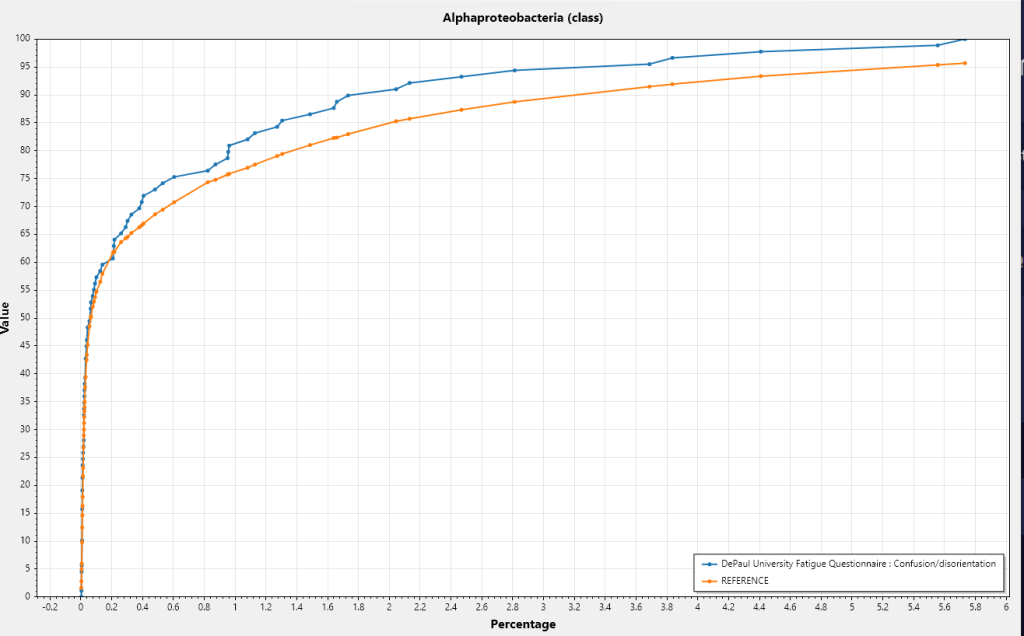
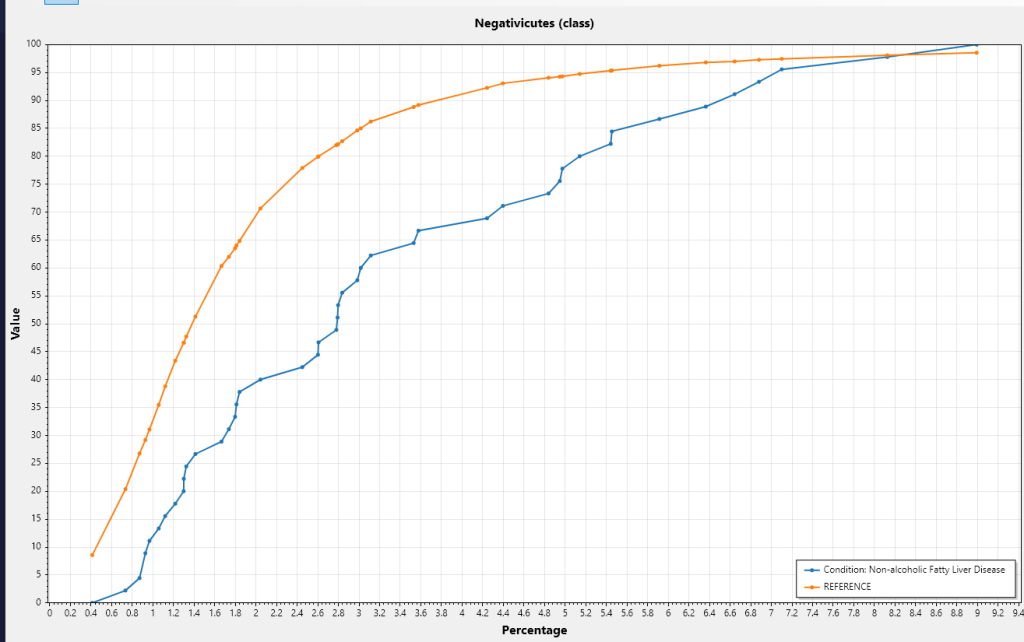
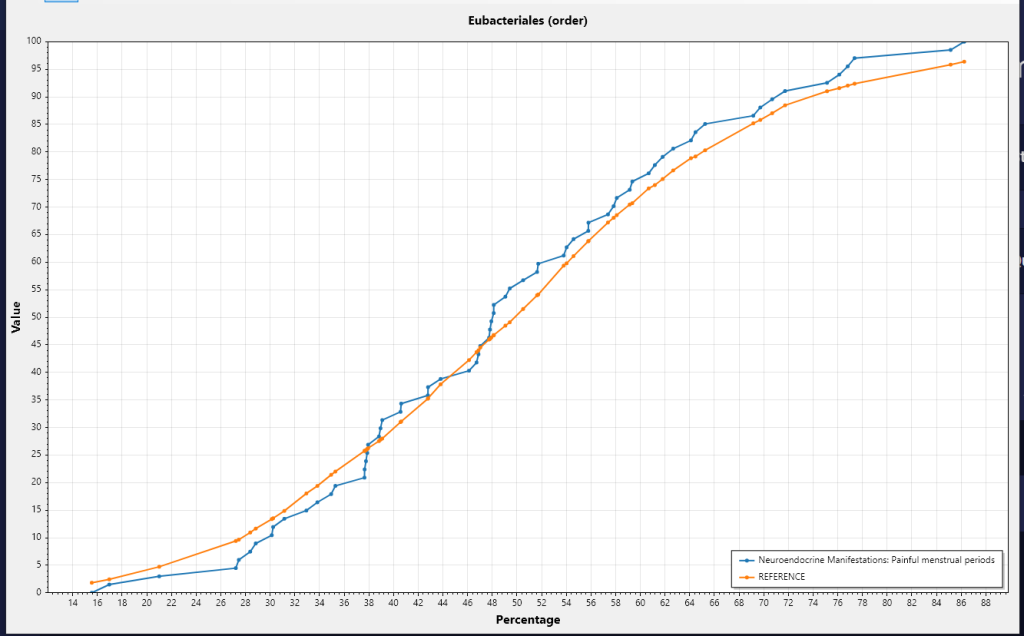
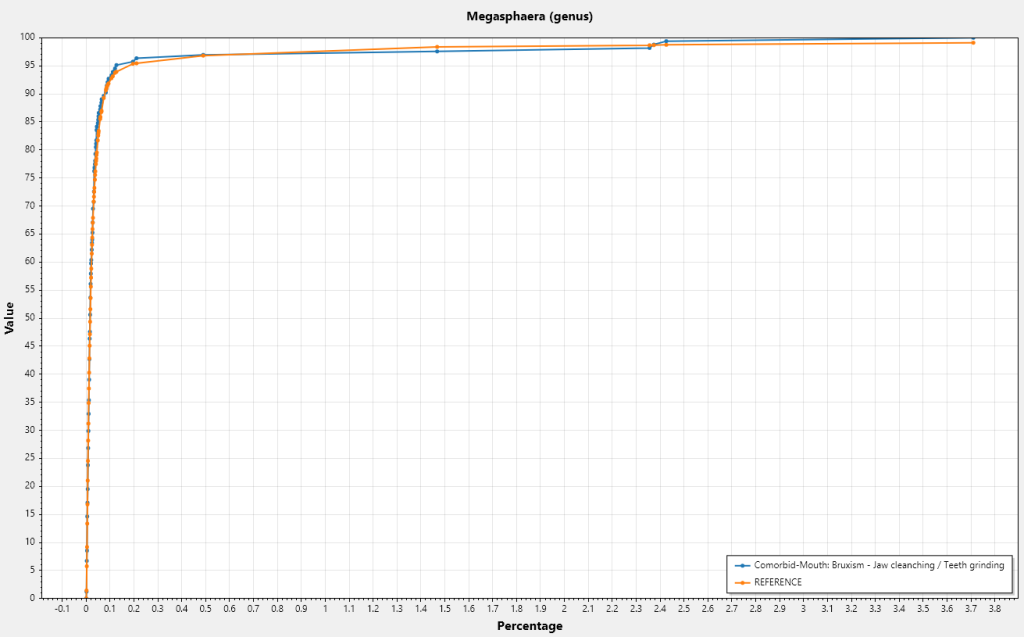
I subsequently came across an odds plot where we have an appearance similar to electron shell densities and not the nice linear model that is often assumed.

The result was a clear need to review a lot more data graphically. There are the main patterns:

  • The condition line is clearly to the left of the reference line, i.e. transformed average is less
  • The condition line is clearly to the right of the reference line, i.e. transformed average is more
  • The condition line is on both sides of the reference line, i.e. a complex situation.
  • The lines are on top of each other — no association to the symptom

Lower Transformed Average

Higher Transformed Average

Mixed Case

No Association

A Video Show

I generated a program to walk through some random bacteria and recorded them in the video below. Pause the video when you want to look at a specific chart in greater detail. My main conclusion is that often a bacteria is significant only when it is in a certain range.

400+ more over 20 minutes

Autism Only

Long COVID